The Enlightenment, spanning the late 17th and 18th centuries, reshaped how people understood the world. It placed reason, inquiry, and individual thought at the centre of intellectual life, challenging long-standing traditions built on superstition and unquestioned authority. While often associated with science and philosophy, its influence extends deeply into modern storytelling, particularly in how narratives balance logic with mystery.
At its core, Enlightenment thinking encourages questioning. Writers and thinkers began to testify religion, power structures, and accepted rituals with a critical eye. This shift laid the groundwork for stories driven by investigation rather than blind acceptance. Today’s mystery, thriller, and historical fiction genres owe much to this intellectual individuals legacy. Characters are no longer passive observers of fate. They analyse, interpret, and seek evidence before drawing conclusions.
One of the most noticeable influences is the rise of the rational protagonist. Whether a detective, historian, or researcher, modern characters often approach problems through observation and deduction. This reflects Enlightenment ideals where knowledge is gained through experience and reasoning. The narrative tension then arises not just from what is unknown, but from how the truth is uncovered step by step.
At the same time, Enlightenment thought did not eliminate belief. Instead, it created an area where belief and reason could coexist in tension. This duality is a powerful tool in storytelling. Writers frequently place characters between two competing interpretations of reality. One grounded in logic, the other shaped by tradition, faith, or personal conviction. The result is a layered narrative where certainty is elusive and meaning must be constructed.
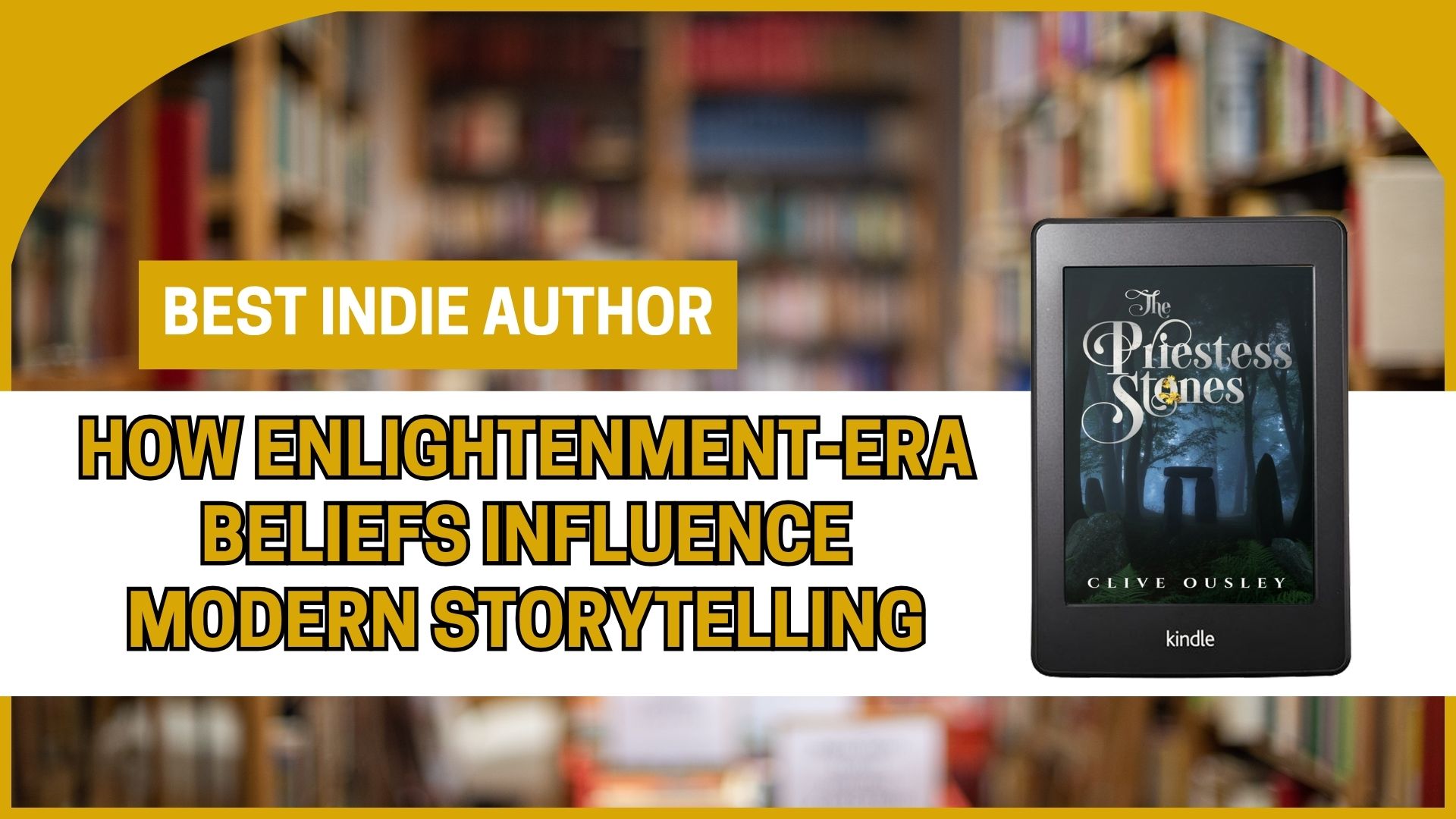
This dynamic is clearly investigated in The Priestess Stones by Clive Ousley. The novel draws on Enlightenment-era elements through its central manuscript, written in a period when scholarly thought and spiritual belief often overlapped. The presence of Latin text, symbolic imagery, and references to ancient practices reflects a time when educated individuals could engage with both intellectual and mystical ideas without seeing them as mutually exclusive.
The story’s investigation into a hidden stone circle mirrors Enlightenment curiosity. Characters examine clues, question assumptions, and rely on emerging tools and knowledge to interpret the past. Yet, alongside this methodical approach, there remains an undercurrent of belief. The idea that the site holds meaning beyond physical explanation challenges the purely rational perspective. This tension drives the narrative forward and keeps readers engaged.
Another lasting influence of the Enlightenment is the emphasis on individual perspective. Modern storytelling often highlights personal interpretation rather than presenting a single authoritative truth. In earlier periods, stories were more likely to reinforce established beliefs. Enlightenment thinking disrupted this by encouraging independent thought. As a result, contemporary narratives allow for ambiguity. Different characters can view the same evidence in entirely different ways, each interpretation shaped by their own experiences and biases.
Historical fiction, in particular, benefits from this approach. By placing modern characters in contact with Enlightenment-era ideas, writers can explore how knowledge evolves. The past is no longer a fixed set of facts but a landscape of competing viewpoints. The Priestess Stones uses this effectively, presenting a document that can be read as either a record of genuine belief or an elaborate construction shaped by its time. This uncertainty invites readers to become part of the investigation.
The Priestess Stones by Clive Ousley captures this influence with clarity. It draws from a period when ideas were shifting, when belief and reason stood side by side, and transforms that tension into a narrative that feels both historical and immediate. Through its layered storytelling, the novel demonstrates how Enlightenment-era thinking continues to shape the way stories are told, experienced, and understood today.
Read this book now, available on Amazon: https://www.amazon.co.uk/dp/B0G3XVSQDJ?.