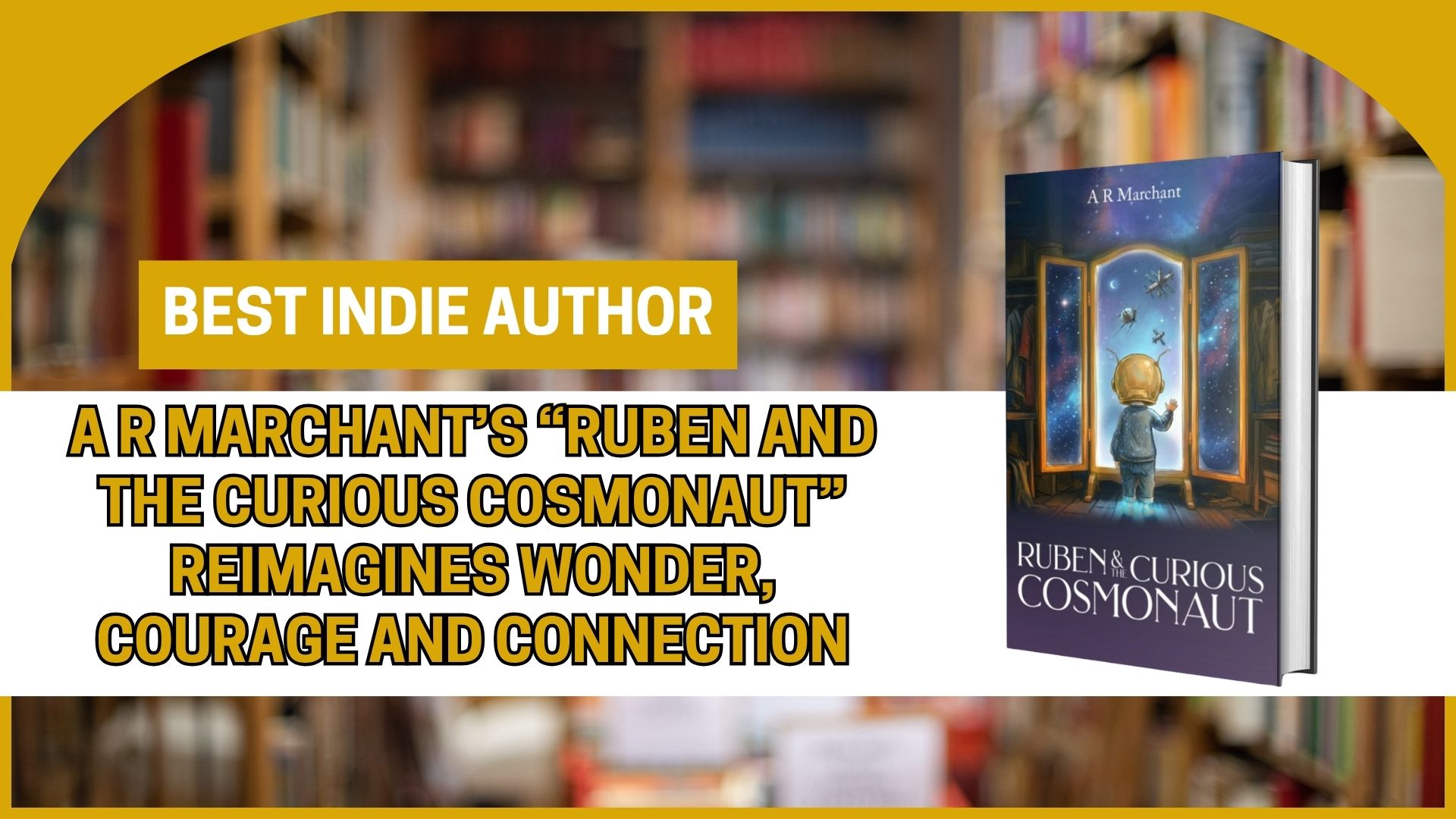
In Ruben and the Curious Cosmonaut by A R Marchant, a simple reflective surface becomes something far more dangerous and far more meaningful than glass. It becomes a threshold. A decision. A responsibility. Ultimately, a doorway into a universe where broken things still matter, where silence has weight, and where even the smallest person can help hold a fading star together.
At the centre of the story is Ruben, a quiet boy who does not begin his journey as a chosen hero. He is not defined by confidence or loud certainty, but by hesitation, observation, and the kind of careful attention that often goes unnoticed. That quietness becomes essential when he discovers a battered helmet in a costume shop owned by Baba, a figure who understands more than he says. When the helmet awakens a shimmering mirror in the storeroom, Ruben steps without spectacle or prophecy into something that feels less like falling and more like the world shifting sideways.
What he finds beyond the mirror is not a clean fantasy realm, but a fragmented expanse known as the Yard. It is a place made of broken structures, suspended debris, drifting machinery and logic that does not immediately explain itself. Above it hangs a sky that refuses certainty, neither day nor night, neither fully real nor entirely imagined. Even sound behaves differently here. It fails to travel normally, and silence becomes its own force of communication.
The mirror, by this point, has become something more than a passage between worlds. What we see, the book suggests, depends on how carefully we’re willing to look, and how honestly we’re willing to act once we do.
Sparky, a small glowing creature, becomes Ruben’s guide and companion. Not a mentor exactly. Sparky is cautious, shaped by long experience of watching things fail, and wary in the particular way of something that has seen a system in slow decline. Together they piece together what the Yard actually is: part of a vast mechanism called the Cosmic Engine, responsible for maintaining connections between distant stars.
When the Engine falters, stars begin to fade. Sparky’s own home among them.
The tasks that fall to Ruben are not spectacular. Align a mirror. Recover a fractured crystal. Restore balance to something that resists anything rushed or careless. Each demands patience and the ability to hold steady when the outcome isn’t clear. These are not the set pieces children’s fiction usually builds towards. Marchant builds towards them anyway.
The most compelling idea in the book sits at the heart of the Yard’s logic. Brokenness is not the same as uselessness. The Custodian, a weathered mechanical guardian, makes this concrete: a cracked crystal is not discarded, it is interpreted. A misaligned mirror is not replaced, it is corrected with care. The whole system operates on the understanding that damaged things still carry memory, purpose, and value. That’s a harder idea to give a child than it sounds, but Marchant pulls it off.
Ruben navigates his own doubt alongside all of this. There are moments when the task feels too large for someone so ordinary. And ordinary is exactly what Ruben is. The tension isn’t resolved by revealing hidden greatness. It’s resolved by insisting the ordinariness was always enough. He doesn’t overcome the Yard by being louder than it. He learns to listen to it.
When the Engine is restored and light returns to distant stars, the moment feels earned rather than triumphant. Collective rather than individual.
Even after his return through the mirror, the story does not end with spectacle. It ends with continuity. Ruben notices the world differently: the light in everyday objects, the meaning in ordinary routines, the quiet signals that things are still connected even when unseen. The universe has not become more magical. He has become more attentive to its existing magic.
Ruben and the Curious Cosmonaut ultimately asks a question that lingers beyond its pages: what if the doors to the universe are not dramatic portals at all, but quiet reflections waiting for someone patient enough to step through them?
In Ruben’s case, the mirror does not simply lead to another world. It reveals that the universe was never separate to begin with, only waiting to be noticed, understood and carefully, courageously repaired.
Ruben and the Curious Cosmonaut is available now from Amazon
https://amzn.eu/d/07ekPNol
www.andymarchant.com