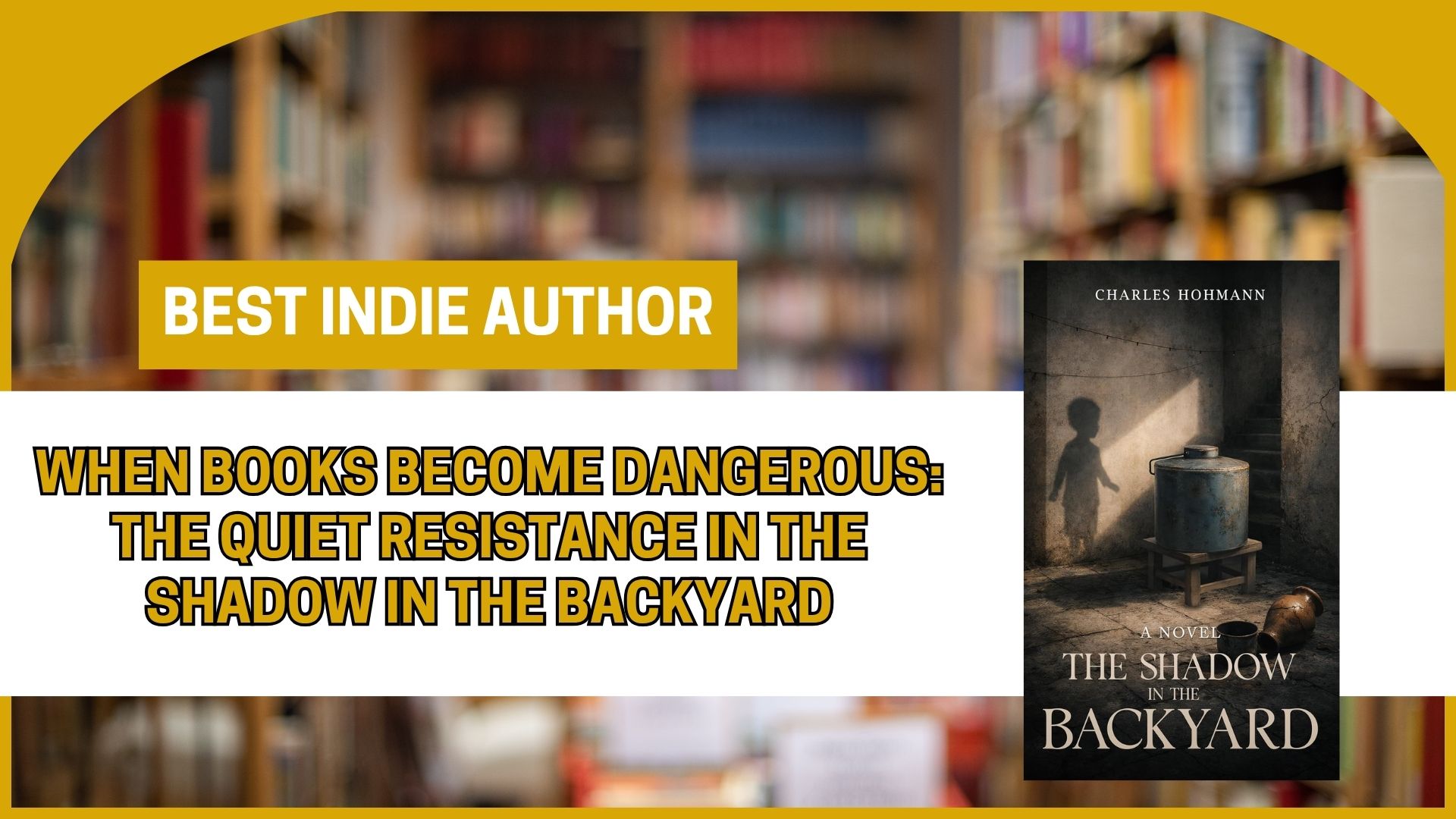
In Charles Hohmann’s novel The Shadow in the Backyard, books are never just objects of knowledge or leisure. They are quiet detonators capable of unsettling political orders, exposing hidden anxieties and reshaping the moral temperature of an entire city.
Set in 1930s Alexandria, the novel captures a world where intellectual life exists under increasing pressure. What begins as a cosmopolitan environment of exchange of languages, ideas and cultures moving through cafés, salons and bookshops gradually transforms into a landscape of caution. Words once spoken freely begin to carry consequences. Even reading becomes an act that requires awareness.
At the center of this shifting world is Louis Schuler, a bookseller whose shop functions as both refuge and risk. In The Shadow in the Backyard, his bookshop is more than a place of commerce; it is a fragile public square where British officers, Egyptian students, expatriates, artists and intellectuals coexist for a moment. But beneath this surface of exchange lies a growing tension: who is listening, who is watching and what can no longer be safely said.
Books in Schuler’s world are not neutral. A novel by Dostoyevsky can feel like a moral provocation. Freud becomes a key to the forbidden interiors of the mind. Marx is no longer a theory but a potential accusation. Surrealism ceases to be aesthetic experimentation and becomes a coded language of dissent. The act of stocking, selling or recommending a book can become an ethical position, sometimes even a political one.
This is where the novel’s central idea emerges: resistance does not always take the form of protest or revolution. In The Shadow in the Backyard, resistance often looks like continuity. It is the quiet decision to keep shelves open, to keep conversations alive, to preserve intellectual space even when the world outside begins to narrow.
As surveillance intensifies in Alexandria, the atmosphere inside the bookshop shifts almost imperceptibly. Customers lower their voices. Certain titles are requested indirectly or avoided altogether. Conversations that once drifted freely between philosophy, politics and art become fragmented, careful and self-editing. Fear does not arrive dramatically; it accumulates.
Yet the novel resists reducing this world to simple oppression. Instead, it shows how fragile and persistent intellectual life can be. Even under pressure, ideas continue to circulate. Even under scrutiny, people still read. And in those private moments of reading, a subtle form of resistance survives, one that cannot easily be measured or controlled.
Marjorie, Schuler’s companion, deepens this dimension of the story. Her cosmopolitan background and linguistic fluency mirror the bookshop’s own hybridity. Together, they inhabit a space where identity is not fixed but translated, negotiated and constantly reinterpreted. Their relationship, shaped by both intimacy and historical uncertainty, becomes part of this broader question: how do individuals remain open to meaning when the world is closing in?
What makes The Shadow in the Backyard particularly resonant is its refusal to separate private life from intellectual life. Love, illness, friendship and reading are all embedded in the same historical pressure system. A cough in a hospital corridor, a closed bookshop door and a whispered conversation between shelves each carries political weight.
Ultimately, the novel suggests that books become dangerous not because they change overnight, but because the world around them does. Meaning remains the same; tolerance for meaning does not. And in that gap, between what is read and what is permitted, quiet resistance takes shape.
In this sense, The Shadow in the Backyard is not only about Alexandria in the 1930s. It is about any moment in history when language becomes suspect, when thought requires courage and when the simple act of reading becomes a way of holding on to freedom without announcing it.
Available on Amazon : https://www.amazon.com/dp/1971228729