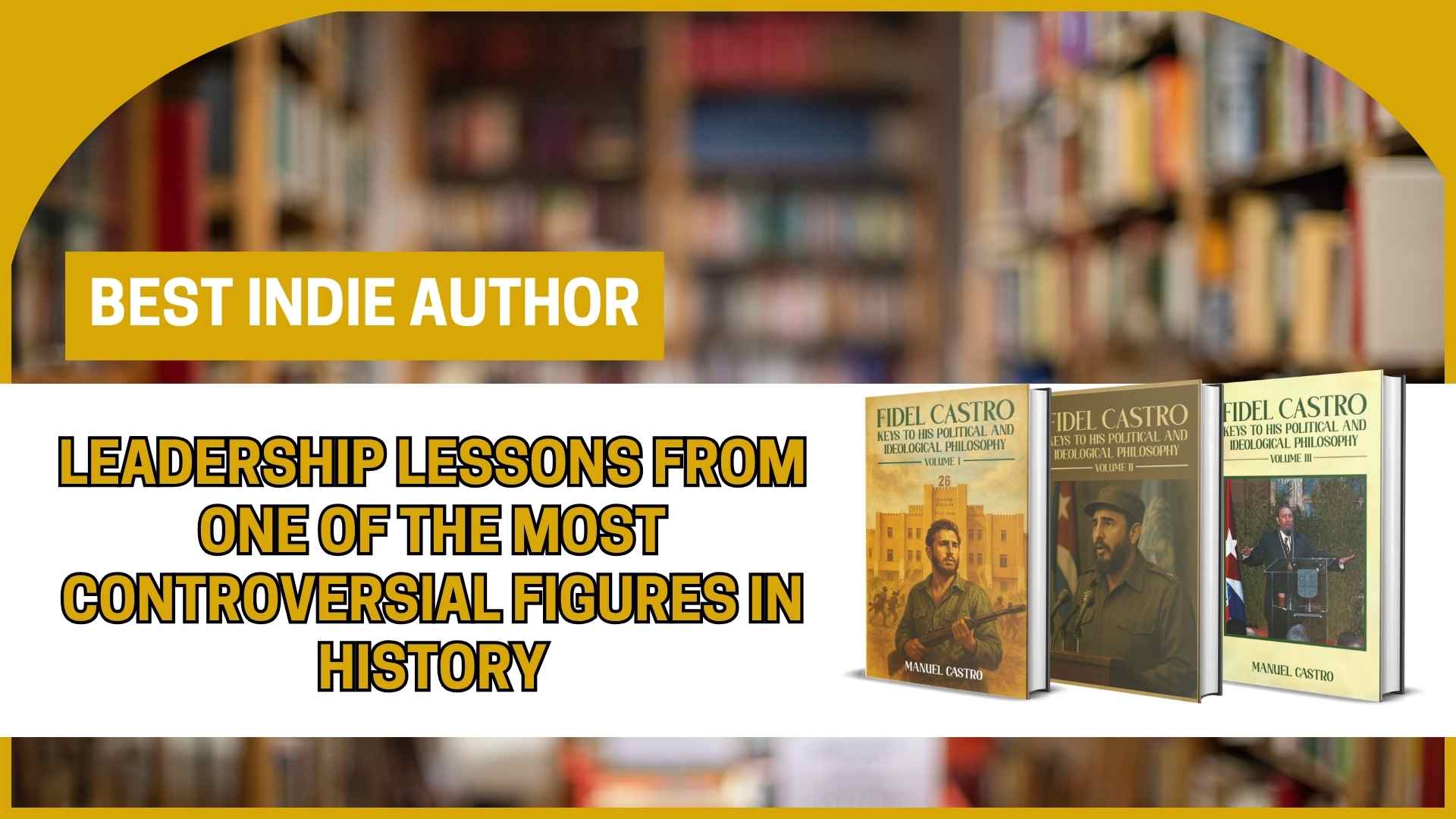
Let’s be honest, when you hear the name Fidel Castro, “leadership lessons” might not be the first thing that comes to mind. He’s one of the most debated figures in modern history, often viewed through sharply divided opinions. But here’s the thing: controversial leaders are often the most revealing when it comes to understanding power, influence and decision-making.
So what can we actually learn from someone like Castro?
That’s exactly the question Manuel Castro explores in Fidel Castro: Keys to His Political and Ideological Philosophy(Volumes I, II and III). Instead of telling a one-sided story, this three-part series digs into the thinking behind the leadership, what shaped it, how it evolved and why it endured.
One of the first lessons? Leadership is rarely accidental.
In Volume I, we see that Castro’s rise wasn’t just about charisma or timing. It was grounded in a deep understanding of his environment, social inequality, political instability and national identity. He didn’t just react to circumstances; he studied them, interpreted them and built a framework of ideas around them. Whether you agree with his conclusions or not, there’s something powerful about that level of intentional thinking. Great leaders, controversial or not, tend to have a clear sense of why they do what they do.
Another takeaway: leadership requires adaptability.
Volume II takes us into the reality of governing where ideas meet real-world challenges. It is one thing to lead a movement; it is another to sustain it. This is where things get complicated and where Castro’s leadership becomes particularly interesting. His ideology didn’t remain static. It evolved as conditions changed, forcing him to constantly reassess strategies and decisions. That flexibility, being able to adjust without completely losing your core vision, is something leaders in any field can relate to.
Then there’s the idea of endurance.
Volume III asks a fascinating question: how does a leader maintain influence over decades, especially under pressure? Castro’s leadership wasn’t just about bold beginnings; it was about longevity. His ability to maintain a consistent ideological narrative, even as the world around him shifted, played a major role in that. It is a reminder that leadership isn’t just about making an impact; it is about sustaining one.
But maybe the most important lesson is this: leadership is complex.
Too often, we try to categorize leaders as simply “good” or “bad,” as if that tells the whole story. Manuel Castro’s trilogy challenges that mindset. It encourages readers to look deeper to understand the motivations, the thoughts and the context behind decisions. Because real leadership, especially on a global stage, is rarely simple.
And that’s what makes this series so engaging. It doesn’t ask you to admire or criticize, it asks you to think. It gives you the tools to analyze leadership in a more nuanced way, using one of history’s most talked-about figures as a case study.
Whether you are interested in politics, leadership, history or just understanding how big ideas shape big decisions, Fidel Castro: Keys to His Political and Ideological Philosophy offers a perspective that’s hard to find elsewhere.
So yes, Fidel Castro was controversial. There’s no getting around that. But if you are willing to look past the headlines and into the ideas, you might find something unexpected: a deeper understanding of what leadership really looks like, messy, evolving and undeniably impactful.
And that’s a lesson worth exploring.