Healthcare does not stop when a patient leaves the doctor’s office. In fact, many of the decisions that shape health happen in the days and weeks between appointments: taking medications, monitoring symptoms, following dietary guidance, staying active and knowing when a change in condition requires attention.
That gap is exactly where AI chatbots may have something valuable to offer.
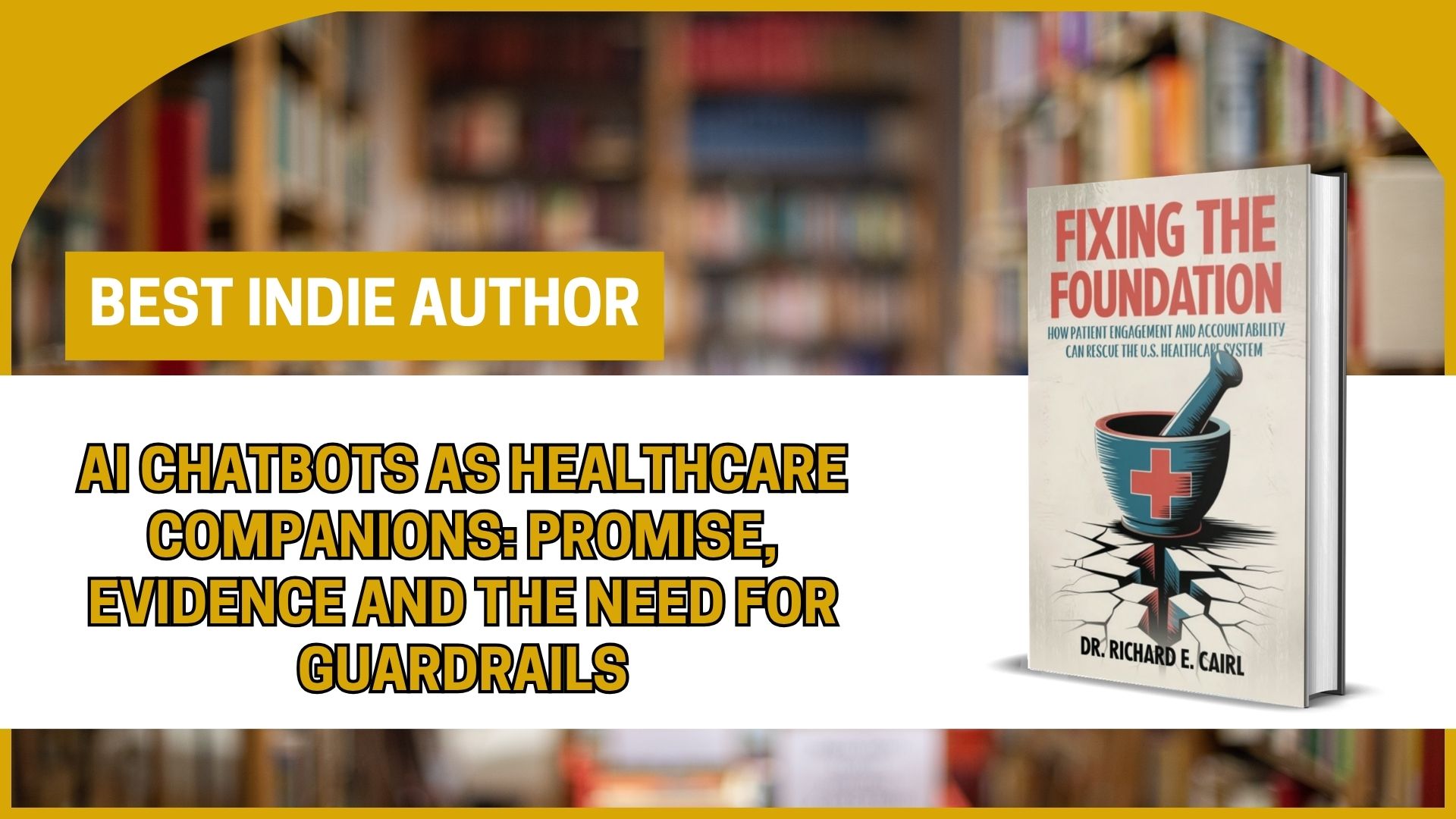
In Fixing the Foundation: How Patient Engagement and Accountability Can Rescue the U.S. Healthcare System, Dr. Richard E. Cairl explores the emerging role of AI-driven chatbots as digital companions that can help patients stay connected to their care outside traditional clinical settings. The book presents these tools not as replacements for doctors, nurses or other professionals, but as potential extensions of the patient-provider relationship.
Their appeal is easy to understand.
AI chatbots can provide reminders, answer routine questions in plain language, encourage self-monitoring, support healthy behavior and help patients follow through on agreed care plans. Dr. Cairl describes how conversational systems can meet patients where they are, delivering timely prompts and small, practical actions that may help turn good intentions into sustained habits.
That can be especially important in chronic disease management.
Patients living with diabetes, hypertension, cardiovascular disease, COPD and other long-term conditions often carry most of the daily responsibility for managing their health. They may need to track measurements, take medications consistently, recognize warning signs and make repeated lifestyle decisions. A chatbot that provides low-friction support between visits may help reinforce those routines and strengthen accountability.
The evidence reviewed in Fixing the Foundation offers reasons for optimism. Dr. Cairl discusses research suggesting that conversational tools can improve areas such as medication adherence, self-management, symptom reporting, physical activity and other behaviors that influence health outcomes.
But the book is equally clear about the cautions.
Not every chatbot is equally reliable. Systems vary in how they are designed, what information they use, how they interact with clinical workflows and when human professionals become involved. For that reason, Dr. Cairl emphasizes the importance of guardrails.
Healthcare chatbots should operate within clearly defined boundaries. Their content should be grounded in reliable sources. Patients should understand what the technology can and cannot do. Privacy, safety, accuracy, transparency and escalation to human care when risk increases must be treated as essential design requirements.
That balance matters because healthcare is not simply an information problem. It is also a relationship built on trust, empathy, judgment and accountability.
A chatbot may be able to remind a patient to take a medication or record a blood pressure reading, but it cannot replace the full depth of a trusted clinical relationship. Its strongest role may be to support that relationship by helping patients remain engaged during the long periods when their healthcare team is not physically present.
This is one of the most forward-looking ideas in Fixing the Foundation. Dr. Cairl does not present AI as a miracle cure for healthcare’s problems. Instead, he places it within a broader strategy centered on patient engagement, shared responsibility, behavioral science and human oversight.
The future of healthcare may be more digital, but if it is going to be better, technology must help patients become more informed, more supported and more actively involved in their own health.
Discover this timely discussion and much more in Dr. Richard E. Cairl’s Fixing the Foundation: How Patient Engagement and Accountability Can Rescue the U.S. Healthcare System.
Read the book on Amazon: https://www.amazon.com/dp/B0GRCRBKB6/