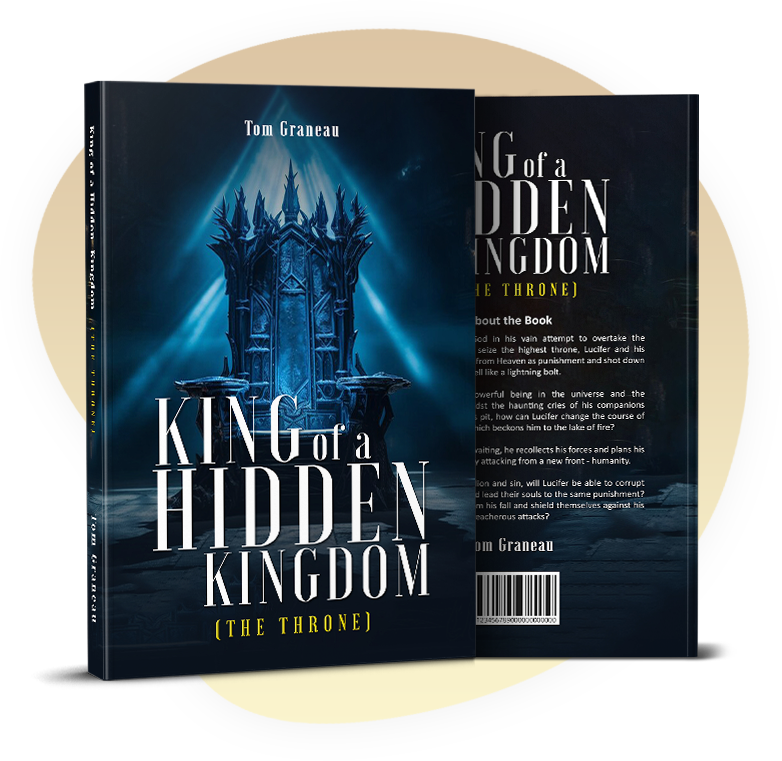
Tom Graneau’s King of a Hidden Kingdom: THE THRONE offers a vivid depiction of the eternal battle between good and evil, centered on Lucifer’s rebellion and his ongoing conflict with God. By intertwining cosmic-scale events with the intimate story of humanity’s creation and fall, the book brings to life the spiritual warfare that shapes moral and existential choices. It portrays the struggle as a battle not only for power but also for influence over human souls, making the conflict deeply personal and universal.
The Catalyst: Lucifer’s Pride and Fall
At the heart of this spiritual war is Lucifer’s pride and his refusal to accept his place within God’s creation. Graneau introduces Lucifer as a once-majestic being who, upon being cast out of Heaven, finds himself in a desolate Hell. His fall is vividly described, from the fiery descent to the crushing realization of his new reality. Yet, even in defeat, Lucifer refuses to submit. His transformation into Satan is fueled by a desire to undermine God’s creation, with humanity becoming the battlefield.
This mirrors the portrayal in Paradise Lost, where Satan’s rebellion stems from his inability to reconcile his subservience to God despite his exceptional gifts. In both narratives, Lucifer’s defiance is not only against authority but also against the very structure of divine order.
The Role of Humanity
Humanity takes center stage in the cosmic conflict. Graneau frames Lucifer’s strategy around humanity’s vulnerability, particularly their free will. The book explores Lucifer’s intent to corrupt humans as a means of wounding God, exploiting their desires and weaknesses to turn them away from their Creator. This highlights the moral stakes of the war: humans are not passive participants but active agents whose choices influence the outcome.
The narrative resonates with Milton’s depiction of Adam and Eve in Paradise Lost. In both works, the human race represents the potential for redemption or ruin, embodying the consequences of sin and the possibility of divine grace.
Heaven’s Defenders: Divine Justice and Love
While Lucifer schemes in Hell, Heaven stands as a bastion of divine justice and unwavering love. In King of a Hidden Kingdom, the archangel Michael serves as God’s military leader, embodying the unyielding righteousness that opposes Lucifer’s rebellion. The description of Heaven’s forces preparing for battle against Lucifer’s army highlights the unwavering strength of good in the face of evil.
This depiction is reminiscent of Dante’s and Milton’s works, where Heaven’s light is portrayed as an ultimate, incorruptible force. However, Graneau adds a layer of intimacy by emphasizing God’s personal involvement with humanity, such as his daily walks with Adam and Eve in Eden. This reinforces the idea that the war is fought out of love as much as justice.
The Stakes of the Conflict
The implications of this spiritual war extend far beyond Lucifer and his followers. Graneau’s narrative stresses that the war’s outcome hinges on human choices. The interplay between free will and divine sovereignty becomes a central theme, presenting humanity as both a target and a participant in the battle. The depiction of Hell’s organization into cities, each tailored to specific sins, underscores the consequences of moral choices.
This differs from Dante’s focus on individual punishment in Inferno and Milton’s emphasis on Satan’s personal vendetta. Graneau’s approach broadens the scope, showing the spiritual war as a dynamic and ongoing struggle with implications for every soul.
In King of a Hidden Kingdom: THE THRONE, Tom Graneau weaves a narrative that brings the spiritual war between good and evil into sharp focus. By highlighting Lucifer’s pride, humanity’s vulnerability, and God’s unwavering love, the book underscores the eternal relevance of this conflict. It challenges readers to reflect on their own moral choices, reminding them that the battle for good and evil is not just cosmic—it is deeply personal.