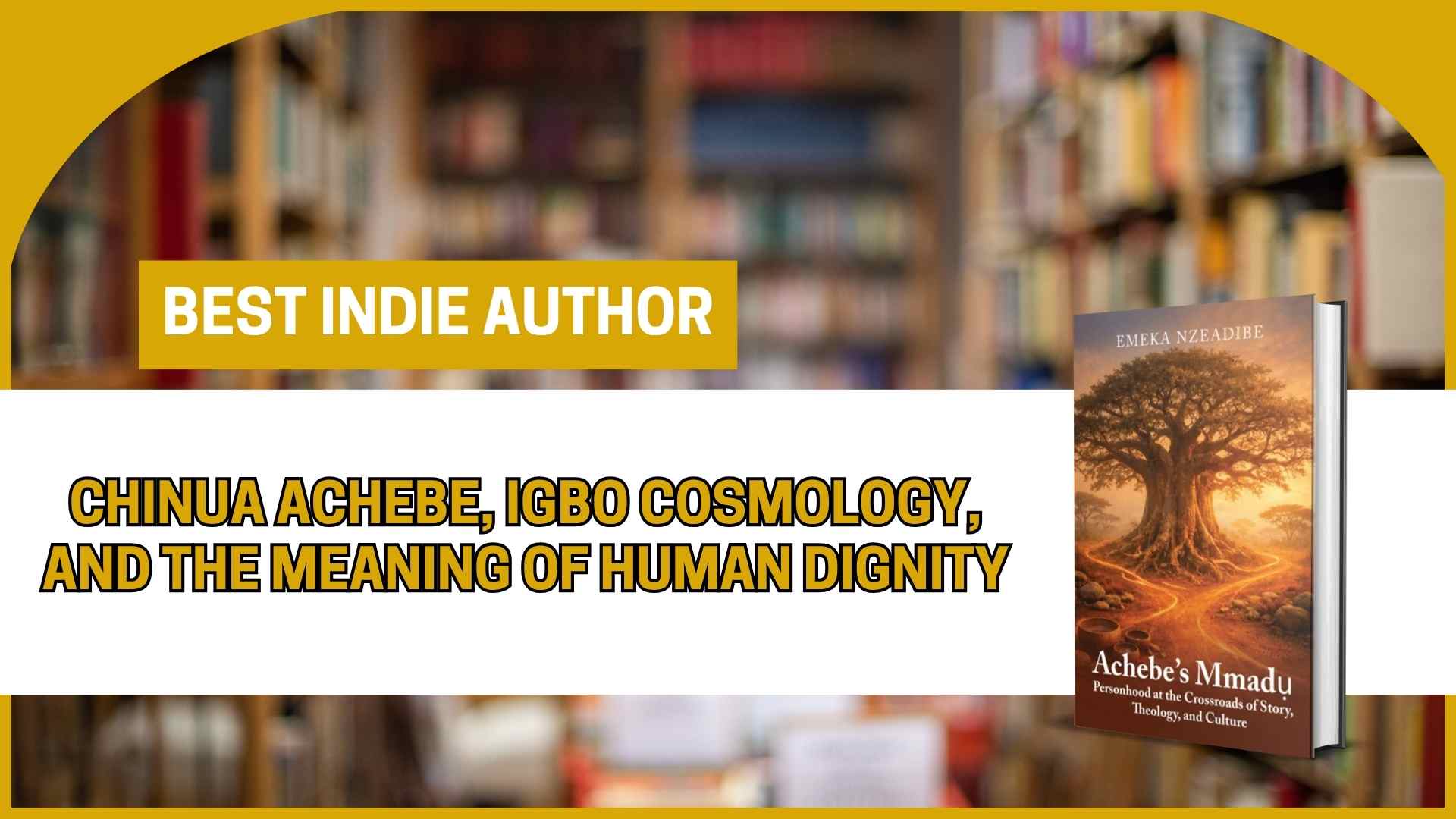
Chinua Achebe gave the world more than unforgettable stories. He opened a doorway into an Igbo universe where life, identity, memory, spirit, and community are deeply connected. In Achebe’s Mmadụ: Personhood at the Crossroads of Story, Theology, and Culture, Emeka Nzeadibe brings this world into focus through the powerful Igbo idea of Mmadụ, the human person.
The book shows that Achebe’s fiction is not only about cultural change or colonial encounter. It is also about the dignity of the human being. Through Achebe’s Igbo world, Nzeadibe presents personhood as something richer than individual success, public status, or private ambition. To be Mmadụ is to be a person of worth, relation, responsibility, and spiritual depth.
Igbo cosmology gives this vision its strength. In Achebe’s world, the human person does not stand alone. Life is shaped by family, village, ancestors, divinity, moral duty, and the unseen forces that give meaning to human existence. The visible and invisible worlds touch each other. Personal choices carry communal weight. Honour, failure, duty, and belonging are never only private matters.
This is where human dignity becomes central. Dignity is not presented as an abstract idea. It is lived through the way people recognise one another, care for the community, honour tradition, and accept responsibility. Nzeadibe shows that Achebe’s characters reveal both the beauty and the difficulty of this vision. Okonkwo, Ezeulu, and others are not simple figures. They carry pride, fear, strength, weakness, longing, and tragedy. Through them, Achebe shows how fragile and precious human dignity can be.
Achebe’s Mmadụ is valuable because it helps readers see African literature as a serious source of thought about humanity. It challenges narrow views of Achebe’s work and places his stories in conversation with theology, culture, philosophy, and human identity. Nzeadibe also connects Igbo personhood with Christian anthropology, especially the belief that every person carries sacred worth. This conversation gives the book a broad reach while keeping Achebe’s Igbo world at its centre.
For today’s readers, the message is deeply relevant. Many people live in a world that often measures human worth by power, wealth, influence, or achievement. Achebe’s Mmadụ offers a different vision. It reminds us that human dignity is found in relation, moral awareness, memory, faith, and the ability to see the other as fully human.
For readers interested in Chinua Achebe, Igbo cosmology, African literature, theology, philosophy, or human dignity, Emeka Nzeadibe’s Achebe’s Mmadụ is a rewarding and necessary book. It invites us to return to Achebe with fresh eyes and to recognise that his stories still speak to one of the greatest questions of human life: what does it mean to be a person?
Get your copy today! https://www.amazon.com/dp/B0GZFB5P25/