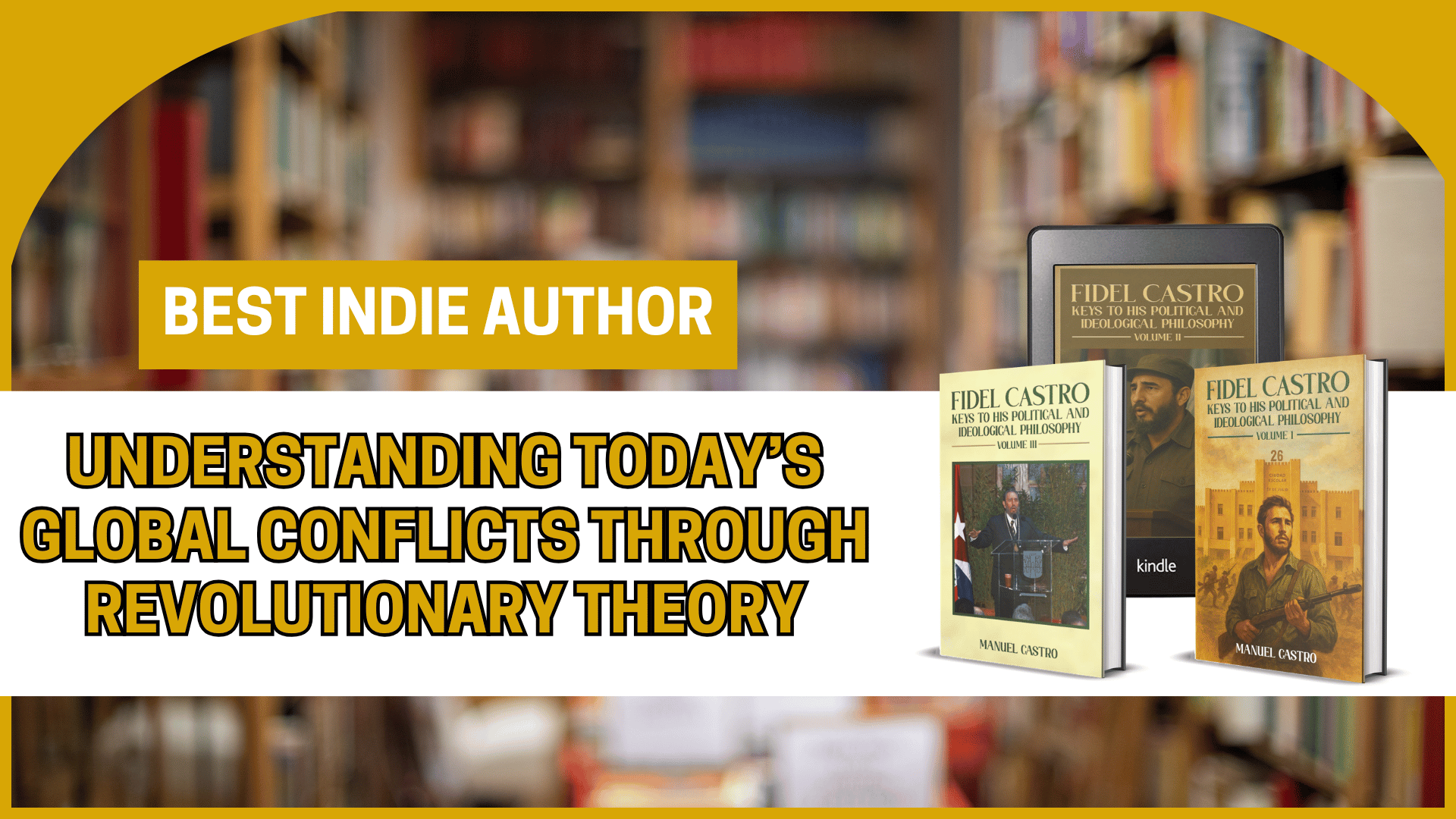
From geopolitical tensions to economic rivalries and ideological divides, today’s global conflicts often seem complex and difficult to interpret. Headlines provide fragments of information, but rarely explain the deeper forces shaping these events. To truly understand why conflicts emerge and persist, it’s essential to explore the ideas and frameworks that drive them. This is where revolutionary theory becomes highly relevant and where Fidel Castro: Keys to His Political and Ideological Philosophy by Manuel A. Castro offers a powerful lens for analysis.
At the heart of this series is the political philosophy of Fidel Castro, a leader whose ideas extended far beyond national borders. His approach to revolution and global politics was rooted in a deep understanding of power dynamics, economic inequality and the struggle for sovereignty. By organizing more than 300 key concepts into a structured framework, the series provides readers with a comprehensive toolkit for examining modern global issues.
One of the most important insights offered by revolutionary theory is the concept of conflict arising from imbalance. According to this perspective, conflicts are not random; they often arise from disparities in power, resources and influence. Economic inequality, political dominance and external interference can create tensions that eventually lead to confrontation. By studying these underlying factors, readers can move beyond surface-level explanations and gain a deeper understanding of global events.
The series also highlights the role of ideology in shaping conflicts. Nations and movements are often guided by specific beliefs about governance, economy and society. These beliefs influence decisions, alliances and strategies. Through the lens of Fidel Castro’s philosophy, readers can explore how ideological differences contribute to both cooperation and conflict on the global stage. This perspective is particularly useful in understanding why certain disputes persist despite diplomatic efforts.
Another key theme explored in the books is sovereignty. In today’s interconnected world, many countries face challenges related to external influence, economic dependency and political pressure. Revolutionary theory emphasizes self-determination and independence, offering a framework for analyzing how nations respond to these challenges. This makes the series especially relevant for understanding conflicts involving territorial control, economic sanctions and international alliances.
The role of people and collective action is also central to this discussion. Conflicts are not driven solely by governments or institutions; they often involve the participation and response of societies. Public opinion, social movements and grassroots activism can all influence the direction of a conflict. The series examines how political consciousness and unity can shape outcomes, providing readers with a more complete picture of how conflicts evolve.
One of the strengths of Fidel Castro: Keys to His Political and Ideological Philosophy is its ability to connect theory with real-world application. Rather than presenting abstract ideas, the books demonstrate how revolutionary principles have been applied in historical contexts. This practical approach allows readers to draw parallels between past events and current situations, making it easier to interpret contemporary conflicts.
Communication also plays a crucial role in shaping global dynamics. Fidel Castro was known for his ability to articulate ideas that resonated across borders, influencing not only his own nation but also international audiences. By examining how messaging and narrative can impact perception and decision-making, the series provides valuable insight into the informational dimension of modern conflicts.
For students, researchers and readers interested in global affairs, this series serves as both an educational resource and an analytical tool. It encourages critical thinking and invites readers to question assumptions, analyze patterns and explore multiple perspectives. In doing so, it transforms the way global conflicts are understood.
In a world where events are often interpreted through limited or biased lenses, having access to a structured and comprehensive framework is essential. Fidel Castro: Keys to His Political and Ideological Philosophy offers that framework, helping readers navigate the complexities of global politics with greater clarity.
Ultimately, understanding today’s conflicts requires more than knowledge of current events; it requires insight into the ideas that drive them. This series provides that insight, making it an invaluable resource for anyone seeking to understand the world more deeply.