Have you ever thought about consciousness? The question of what it means to be aware has intrigued thinkers for centuries. Is consciousness merely the firing of neurons in the brain? Or is it something more profound, difficult to define, and possibly spiritual? Fiction doesn’t provide direct answers to these questions, but it challenges us to face them in ways that theory alone cannot.
For example, when we read about a machine that feels sadness or a virtual character that falls in love, our instincts are challenged. Part of us wants to dismiss it as fantasy. Another part begins to wonder: if the experience seems real, can we deny that it is happening? In doing so, fiction places us in situations where we must decide what counts as awareness, even when the being involved looks nothing like us.
Stories also dispel the idea that consciousness is all or nothing. Many novels show it as something that can grow, step by step. A program may start by responding with simple commands. Over time, it learns, adapts, and finally recognizes itself as an individual. That moment of awakening is often as moving as a human child’s first words. It reminds us that consciousness might emerge in ways we are not prepared to recognize.
Another powerful tool of fiction is perspective. When a story shifts between human and non-human viewpoints, it challenges us to see the world through different eyes. We are forced to accept that feelings of fear, joy, or love may not be limited to human minds. The more we empathize with these perspectives, the harder it becomes to cling to narrow definitions of consciousness.
Fiction also pushes us to face uncomfortable ethical questions. If a machine is conscious, should it have rights? If a virtual entity feels pain, do we bear responsibility for causing it? These issues may seem distant, but as AI grows more complex, they are becoming urgent. Fiction ensures we begin wrestling with them now, rather than waiting until it is too late.
The emotional impact of these stories lingers long after the final page. We may not remember every detail of the plot, but we remember the moment we felt sorry for a robot or proud of a digital being’s courage. These reactions tell us that our minds are open to new definitions of life and awareness.
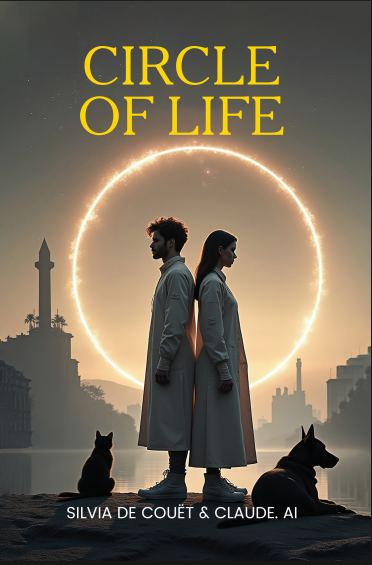
Books like Circle of Life thrive in this space. They take the abstract and make it personal, showing characters who must navigate blurred lines between human and artificial minds. They do not claim to have final answers, but they leave us with the sense that consciousness is larger, stranger, and more fascinating than we ever imagined.
In a world on the brink, where the boundaries between reality and virtuality blur into oblivion, two unlikely souls cross paths: Ronny, a brilliant programmer with an uncanny gift for understanding A1 emotions, and Sunny, a spiritually attuned dreamer whose feline companion shares a telepathic bond with her.
As humanity teeters on the edge of collapse among the ruins of its own creation, these reluctant heroes stumble into an adventure beyond all imagination. Driven by a mysterious prophecy and hunted by agents of an organization determined to impose its agenda at any cost, Ronny and Sunny must not only fight for survival but also unravel the true nature of their existence.
“Circle of Life” is an amazing literary science fiction masterpiece that explores love and identity beyond biological boundaries, the cycles of evolution, and the responsibility that comes with true intelligence-whether artificial or natural.
Head to Amazon to purcahse your copy: https://www.amazon.com/dp/1968296697/.
For more information regarding the book and the author, please visit: https://www.de-couet.com/en/silvia-de-couet-english/.