Rome understood power.
It was displayed in marching legions, fortified cities, political authority and the sharp edge of a soldier’s sword. Across the ancient world, Rome imposed order through discipline and force. For a Roman soldier, strength meant obedience, courage and unquestioned loyalty to Caesar.
Gaius Octavius Marcellinus understands that world completely.
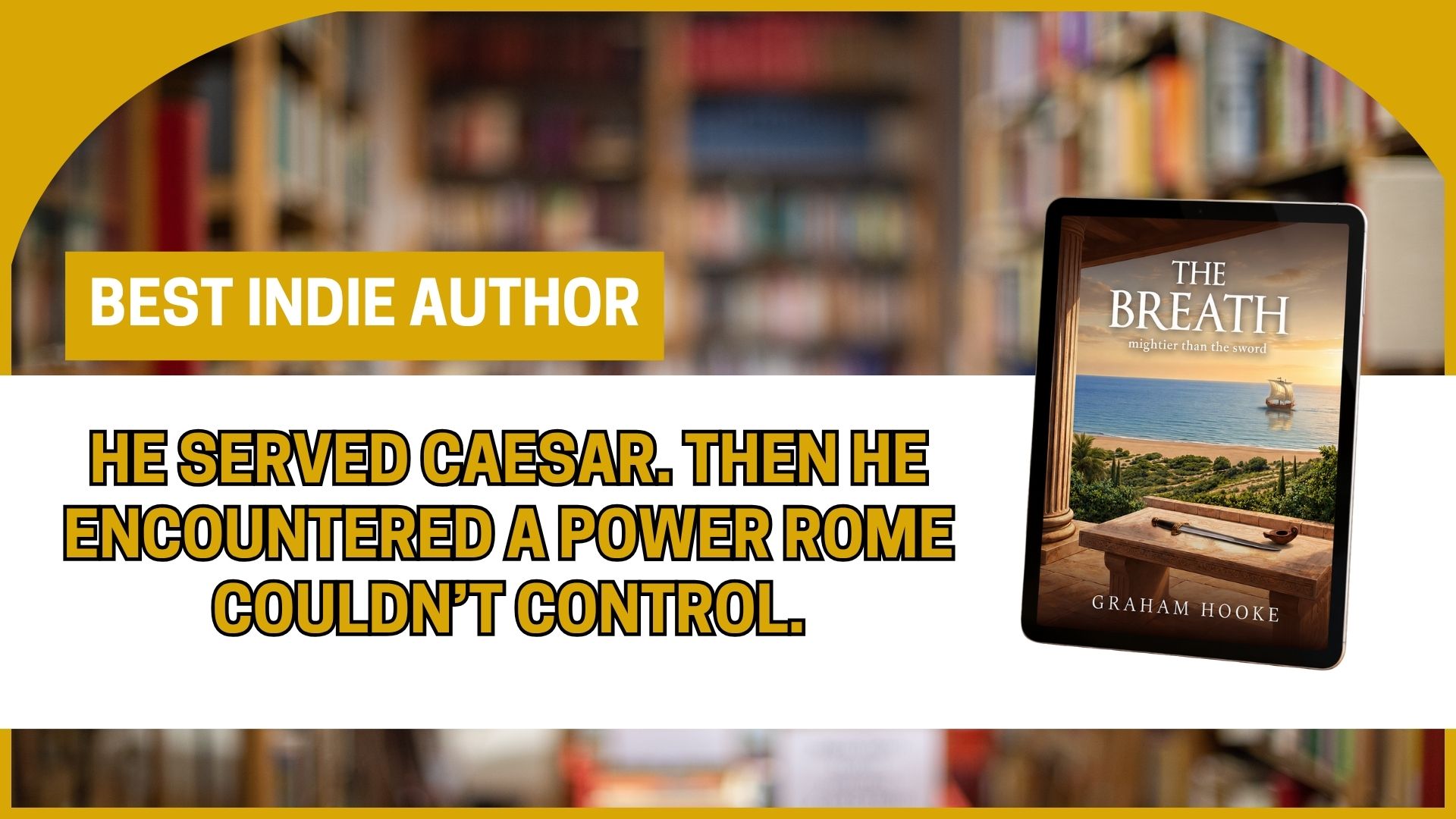
In The Breath: mightier than the sword, a Biblical novel by Graham Hooke, readers enter the turbulent first century through the eyes of this Roman soldier, a man shaped by violence, loss and allegiance to the most powerful empire of his age.
Marcellinus does not begin his story as a seeker of faith. Far from it.
The murder of his parents leaves deep wounds and military life gives him somewhere to direct the anger he carries. Enlisting in the Roman army as a young man, he learns to survive through discipline and strength. Eventually, his service brings him to Judaea, where Rome’s authority is constantly tested by religious tension, political unrest and resistance.
Here, Marcellinus witnesses what imperial power looks like at close range.
During unrest surrounding Pontius Pilate’s aqueduct project, Roman soldiers are sent into a crowd of Jewish protesters. The resulting brutality leaves Marcellinus troubled by what he has helped to do, particularly because his own mother was Jewish. Beneath the armour, questions are already beginning to form.
Then something even more unsettling happens.
Jerusalem becomes filled with reports about followers of the recently crucified Yeshua of Nazareth.
At Shavuot Pentecost, Marcellinus finds himself watching as Peter addresses a huge crowd. There is talk of resurrection, repentance and the Spirit of God. Marcellinus witnesses something he cannot reduce to military tactics or political rebellion: ordinary people being transformed by an invisible presence, the Breath.
Rome knows how to confront an army.
But how do you fight a movement whose followers are willing to suffer rather than surrender their faith?
How do you defeat people who answer hostility with forgiveness?
And what happens when the real battlefield is no longer the streets of Jerusalem, but the heart of the soldier himself?
These questions drive The Breath.
Marcellinus encounters miracles, persecution and men and women whose allegiance to Yeshua challenges everything he has been taught about authority. His journey brings him into the world of Peter, Gamaliel, Cornelius, Timothy, Luke and Paul as the movement known as The Way spreads far beyond Jerusalem.
Yet his transformation is not immediate.
For years Marcellinus resists the very power he keeps encountering. His loyalty to Rome, his pride, his guilt and his grief become walls around him. His greatest conflict, he eventually recognises, is his lifelong “battle with the Breath.”
That struggle gives Graham Hooke’s novel its emotional force.
Against a backdrop stretching from the beginnings of the early Church to persecution under Rome and the eventual fall of Jerusalem, the novel explores an enduring contrast: the power of the sword and the power to transform a human heart.
Rome could command obedience.
Rome could imprison.
Rome could persecute.
Rome could kill.
But there were some things even Rome could not control.
For readers of Biblical and historical fiction, The Breath: mightier than the sword offers a vivid journey into the world of Acts through one Roman soldier’s struggle with faith, power, forgiveness and redemption.
Discover The Breath: mightier than the sword by Graham Hooke (MA PGCE), available on Amazon.
Read the book on Amazon: https://a.co/d/0bUn7xwq