Around the world, governments and institutions are racing toward modernization. Artificial intelligence is transforming public services, automation is reshaping industries and digital systems are becoming the backbone of economic development. On the surface, this technological expansion appears to signal progress, efficiency and innovation.
But beneath the excitement lies a governance crisis few leaders are willing to confront.
Technology is advancing faster than institutions can absorb, manage or sustain it.
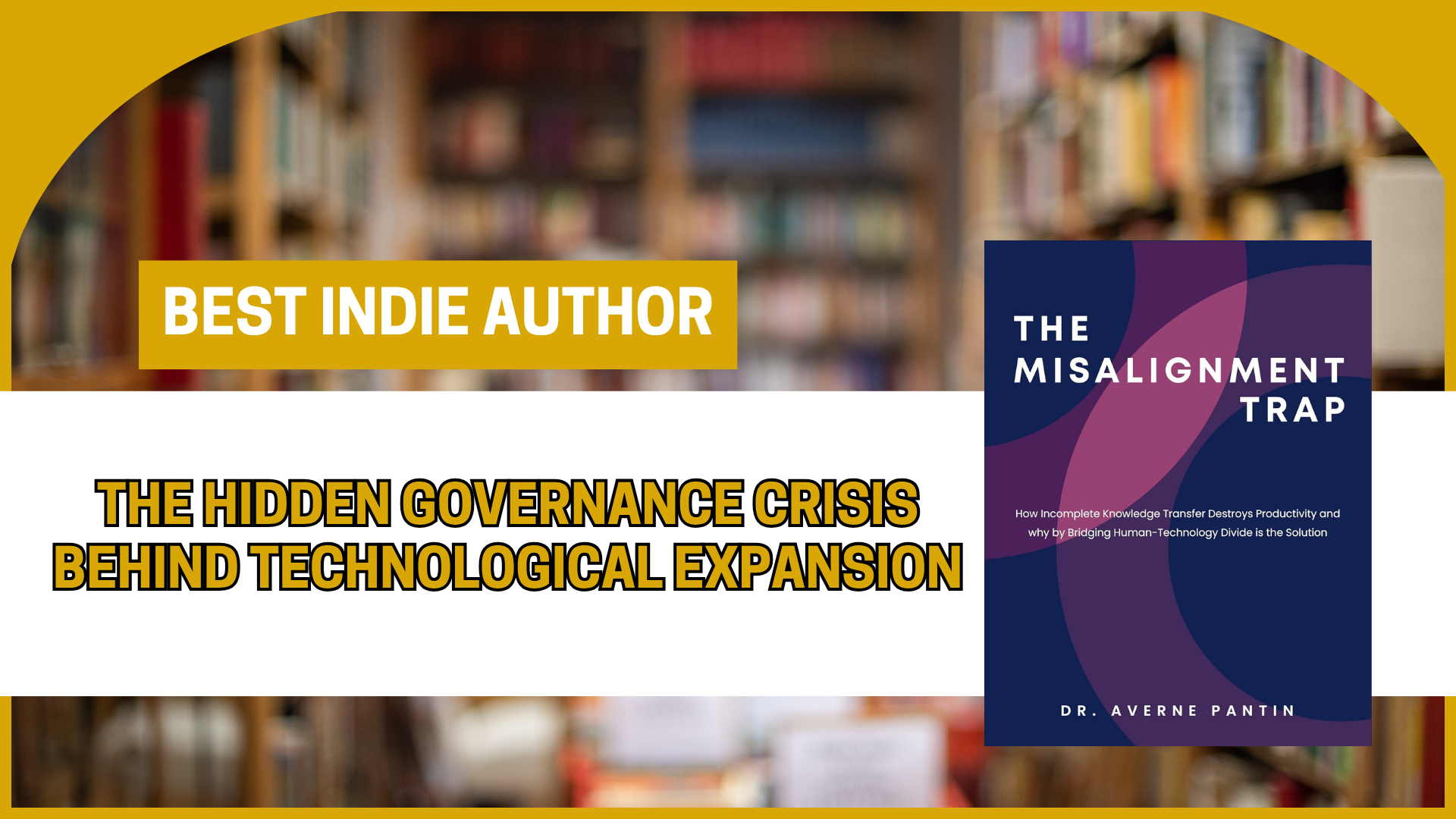
As explored in The Misalignment Trap by Dr. Averne A. Pantin, the greatest threat facing modern institutions is not a lack of technology but a lack of alignment between systems, leadership and human readiness.
This crisis is subtle because technological growth often creates the illusion of success. Governments launch digital initiatives. Corporations invest heavily in new platforms. Organizations celebrate modernization milestones and showcase impressive infrastructure upgrades.
Yet many of these systems quietly underperform after implementation.
Why?
Because modernization is frequently pursued as procurement rather than preparation.
New technologies are installed before institutions build the absorptive capacity required to sustain them. Employees receive condensed training programs that focus on operation instead of understanding. Leadership prioritizes rapid deployment over long-term learning. The result is a system that functions technically but fails organizationally.
The consequences are far-reaching.
Public agencies become dependent on external consultants to interpret systems they were supposed to manage independently. Decision-making grows increasingly reactive because institutional understanding remains shallow. Departments operate in silos, interpreting data differently and struggling to coordinate effectively. Over time, inefficiency becomes normalized.
This is the hidden governance crisis behind technological expansion: institutions are modernizing structurally while remaining underdeveloped cognitively.
The danger intensifies when governments equate technological adoption with national progress. Across many countries, digital reforms are introduced without parallel investments in education, leadership continuity or institutional learning. Citizens are expected to adapt to systems that outpace their readiness, while frontline workers struggle to translate complex technologies into practical service delivery.
The result is not empowerment, but dependency.
As Dr. Pantin argues, technology cannot simply be imported and expected to function sustainably. Knowledge must be localized, reinforced and embedded in the culture of the institution. Without this process, modernization creates fragile systems that rely permanently on external expertise.
This fragility has both economic and social consequences.
When institutions fail to fully understand the technologies they deploy, maintenance costs rise, productivity declines and innovation slows. More importantly, public trust begins to erode. Citizens experience systems that appear modern but feel unreliable. Employees lose confidence in processes they do not fully understand. Leaders become trapped in cycles of short-term fixes instead of long-term development.
The governance issue, therefore, is not technological complexity alone. It is the failure to build an institutional rhythm, the continuous cycle of learning, reinforcement, reflection and adaptation necessary for sustainable progress.
Strong governance requires more than digital infrastructure. It requires institutional memory, leadership stability and cultures where learning is treated as a permanent function rather than a temporary phase of implementation.
The most successful institutions understand this principle clearly. They protect learning time as seriously as operational performance. They invest in mentorship, documentation and feedback systems. They recognize that technology only succeeds when people understand it deeply enough to sustain it independently.
In the end, the future of modernization will not be determined by who adopts technology first.
It will be determined by who develops the governance capacity to understand, manage and evolve with it over time.
Because technological expansion without institutional alignment does not create resilience.
It creates fragility disguised as progress.
Available On Amazon. https://www.amazon.com/dp/B0GKQ61PJ2/