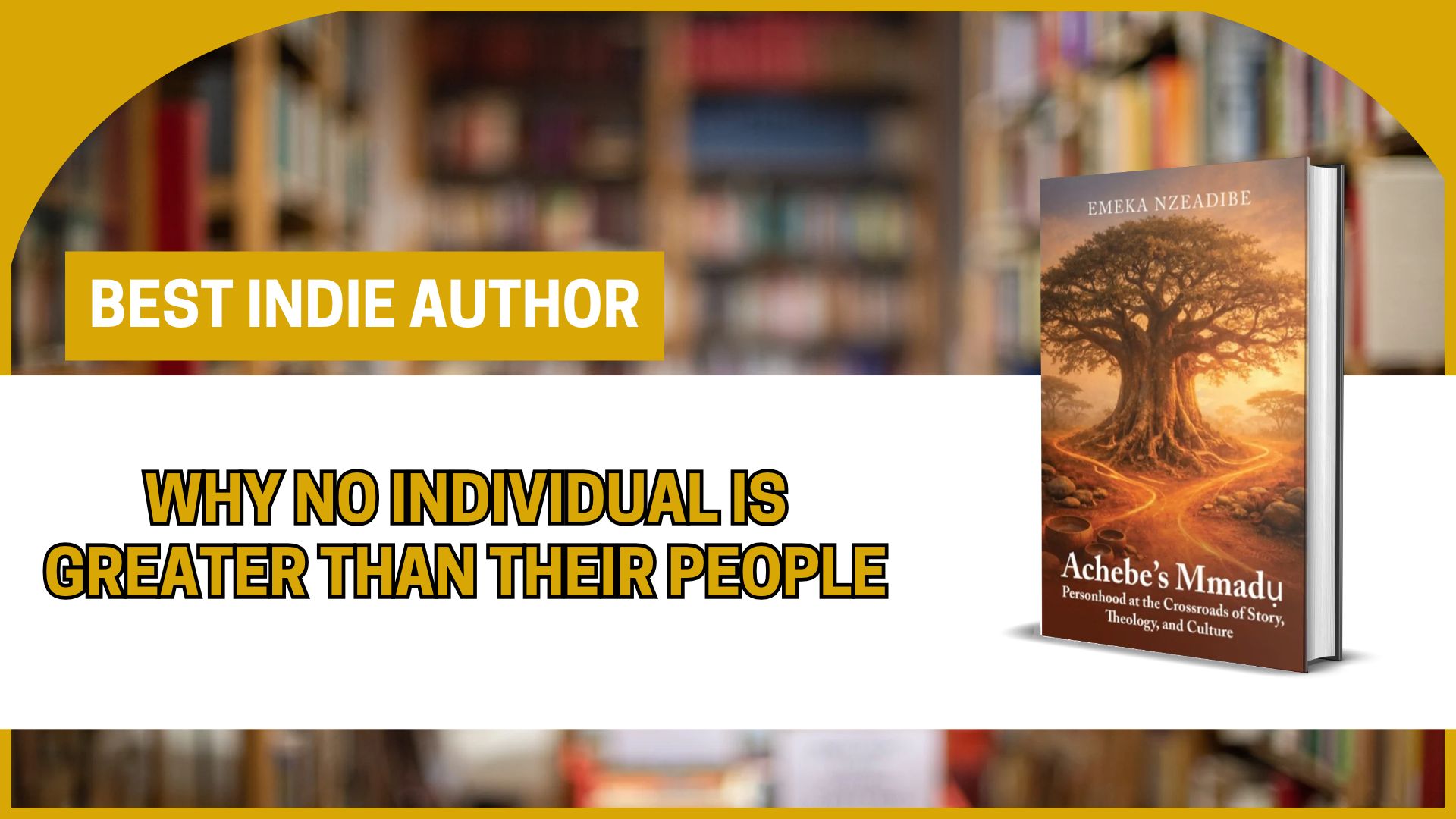
Believe it or not, we are getting obsessed with the myth of the self-made individual, wherever we are. This goes from corporate boardrooms to self-help literature; and we are continually taught to celebrate the lone hero and become the visionary who pulls themselves up by their bootstraps, defies societal norms, and carves out a destiny purely through private willpower. In contemporary Western thought, personal autonomy is placed on a pedestal. This treats the community as a secondary backdrop or, worse, an obstacle to individual freedom. But when we step outside these narrow, hyper-individualistic frameworks and examine indigenous African philosophies of the Igbo people as explored in Emeka Nzeadibe’s monograph Achebe’s Mmadụ: Personhood at the Crossroads of Story, Theology, and Culture, we get to see the radically different and humbling truth about humanity.
In the traditional Igbo universe, human life is fundamentally relational. As captured by the foundational philosophical maxim Ife kwụlụ, ife akwụdebe ya (“Where something stands, something else stands beside it”), nothing in the cosmos exists in isolation. An individual human being (Mmadụ) is always enmeshed in a living, breathing network of kinship, community, and ancestral heritage.
This relational ontology means that identity is not a self-enclosed achievement that we can attribute to ourselves only. One’s existence, security, and social validation are inextricably tied to the collective body, or the oha. In rural Igbo societies, which operated as vibrant, acephalous mini-states without central kings or absolute monarchs (Igbo Amaghi Eze), governance was a collective responsibility, where decisions were forged through consensus by councils of elders (ndichie). They ensure that wisdom is viewed not as the property of a single brilliant mind, but as a collective resource shared among the community. As an insightful Igbo proverb reminds us, “Wisdom is like a goatskin bag; every man carries his own,” yet that bag is brought to the public square for the benefit of all.
To understand the severe dangers of forgetting this principle, we need look no further than the masterclass storytelling of Chinua Achebe, whose novels Things Fall Apart and Arrow of God serve as deep explorations of human ambition and communal limits. Achebe’s iconic protagonists, including Okonkwo and Ezeulu, are prime examples of individuals who ultimately clashed with their own communities and suffered tragic downfalls.
Okonkwo, driven by an obsessive, hyper-individualized fear of weakness and failure, sought to impose his rigid, unyielding standards on a community that valued balance and moderation. He acted independently, disregarded communal sensitivities, and ultimately isolated himself from the social fabric, leading to a tragic, ignominious end.
Similarly, Ezeulu, the brilliant and complex Chief Priest of Ulu in Arrow of God, allowed his personal pride, wounded ego, and an inflated sense of self-importance to interfere with his sacred duty to his people. Convinced he was merely executing his god’s will, Ezeulu weaponized his priestly authority during a critical famine, refusing to compromise with the elders who pleaded for the community’s survival. In doing so, he committed the ultimate error: he set himself apart from and against his clan.
The climax of Arrow of God delivers an unforgettable theological and sociological lesson. As Nzeadibe notes in Achebe’s Mmadụ, the novel concludes with a powerful reaffirmation of ancestral wisdom: “that no man, however great, was greater than his people; that no one ever won judgement against his clan.” When Ezeulu pushed his standoff too far, his god abandoned him, his people turned to alternative pathways, and he crumbled into psychological ruin. His individual greatness could not—and should not—override the community’s collective survival.
Whenever leaders, institutions, or individuals become detached from the communities they are meant to serve, corruption and collapse inevitably follow, which we can clearly witness and experience in real time. In short, in this era where almost every place is fractured by political polarization and self-serving ambition, the Igbo principle of communal primacy serves as an anchor that asserts that strength is never found in ruthless self-reliance or the domination of others. It is found in mutual accountability, empathy, and service to the collective good.
When you understand that no individual is greater than their people, you welcome liberation. It frees you from the exhausting illusion that you must carry the weight of the world entirely on your own shoulders. By embracing our deep relational roots and recognizing that our individual flourishing depends upon the health of the community, we align ourselves with the true heartbeat of human dignity. As Achebe’s Mmadụ brilliantly illustrates, our lives only find their truest meaning when we walk hand-in-hand with those who stand beside us.
Whether you are deeply passionate about African literature, eager to explore intercultural theology, or simply searching for a more relational understanding of what it means to be human, this book is an absolute must-read that will teach you the meaning behind being human and kind, with others and yourself as well.
Through proverbs, myths, and narratives, a culture continues to speak. Emeka Nzeadibe’s book shows that when those voices are heard carefully, they can enrich not only one community’s understanding of humanity but also the wider human conversation.
Read the book on Amazon: https://a.co/d/0363OG8A
Visit the Author’s Official Website: https://achebesmmadu.com/