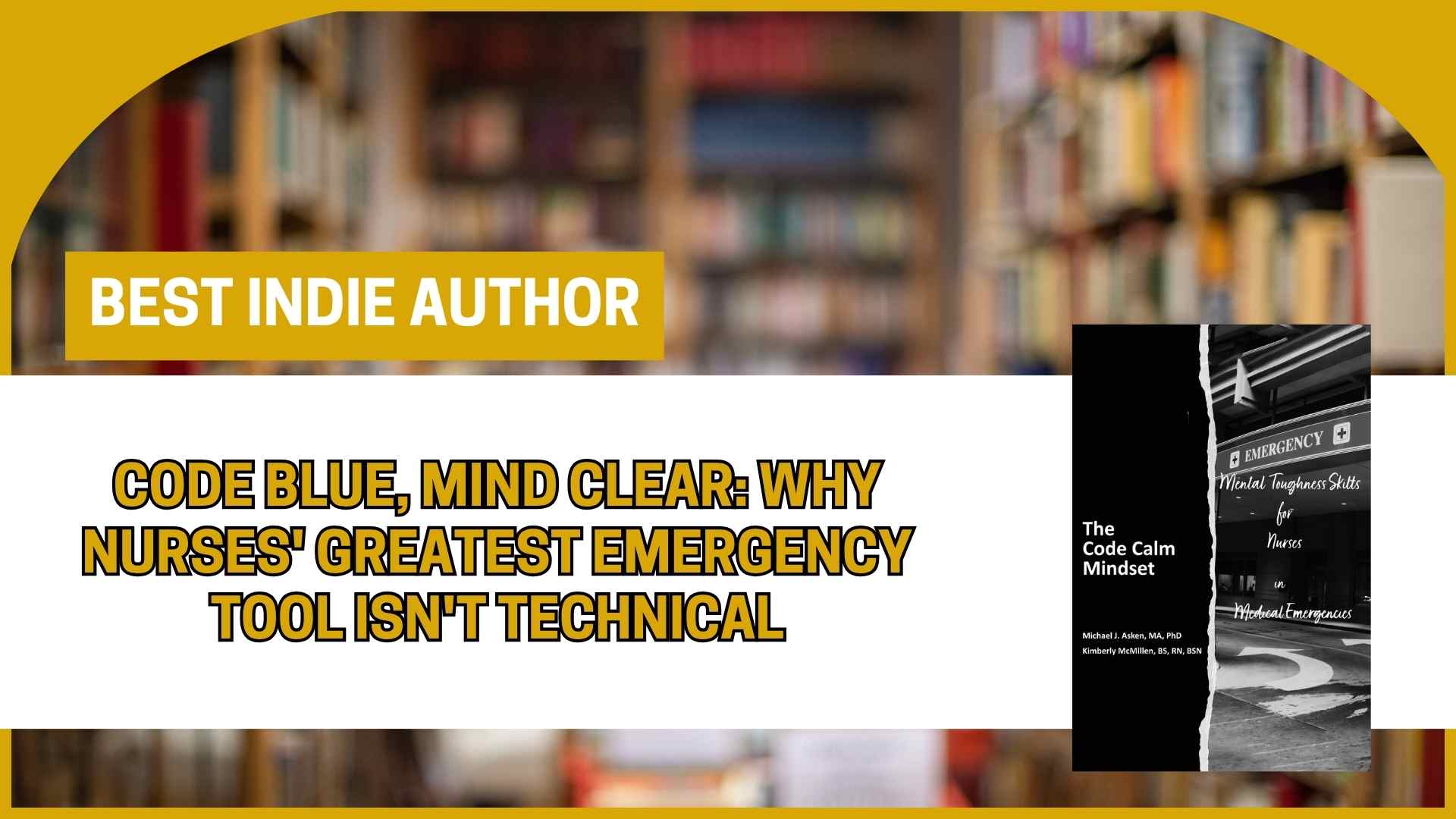
The monitor alarms. A patient’s pressure drops. Within seconds, a room full of people is moving, and one nurse becomes the calm center everyone else orbits around — or doesn’t. What decides which nurse she becomes in that moment isn’t how many IVs she’s started or how well she memorized the ACLS algorithm. It’s something far less visible, and far less discussed: her mind. That’s the premise behind The Code Calm Mindset, a book by psychologist Michael Asken and nurse Kimberly McMillen that makes a compelling case for an uncomfortable truth — nursing education has spent decades sharpening technique while leaving the psychology of crisis performance almost entirely untouched.
Ask any experienced nurse what separates someone who thrives in a code from someone who freezes, and the answer rarely lands on skill. It lands on composure. Asken and McMillen back this up with striking figures: emergency performance, by their estimate, is often thirty to ninety percent psychological. Yet walk through the index of any standard nursing textbook and you’ll find pages devoted to psychosocial care of patients — communication, empathy, grief support — and almost nothing on the psychological skills nurses need to steady themselves. The profession has built an entire architecture around managing the emotions of others while offering almost no formal instruction on managing your own under fire.
This isn’t a small oversight. The authors point to research showing that many nurses, even after rigorous CPR training, report hesitation and self-doubt when defibrillation or rapid decision-making is required. That hesitation isn’t a character flaw. It’s what happens when the nervous system hasn’t been trained the way the hands have. A nurse can execute a procedure flawlessly in a simulation lab and still feel her thoughts scatter when the stakes become real and irreversible.
What gives the book its weight is its refusal to romanticize toughness as grit or bravado. Borrowing from the world of elite performance — Olympic athletes, Navy SEALs, emergency physicians — Asken and McMillen frame mental toughness as a trainable skill, not an innate trait some nurses have and others simply lack. Techniques like controlling the body’s sympathetic arousal, using imagery to rehearse high-stakes scenarios, and reshaping internal self-talk aren’t soft add-ons to clinical training. They’re presented as the missing infrastructure that determines whether technical knowledge translates into action when it matters most.
There’s something quietly validating in this reframing. Nurses have long been told, implicitly, that anxiety in a crisis is something to push through and never mention. The Code Calm Mindset suggests the opposite: that the racing heart and the tightening chest are simply signals the body hasn’t yet been given the tools it needs, and that those tools can be taught, practiced, and mastered like any other clinical competency.
For a profession defined by split-second, life-or-death decisions, the message is overdue. Technical skill will always matter. But Michael Asken and Kimberly McMillen make the case, convincingly, that the mind reaching for that skill in the worst moment of someone’s life deserves training too — not as an afterthought, but as the foundation everything else stands on.
Ready to train your mind for the moments that matter most? Discover practical psychological skills for staying calm, focused, and confident under pressure in The Code Calm Mindset.
Get your copy today: https://www.amazon.com/dp/B0CRXMQZFR/