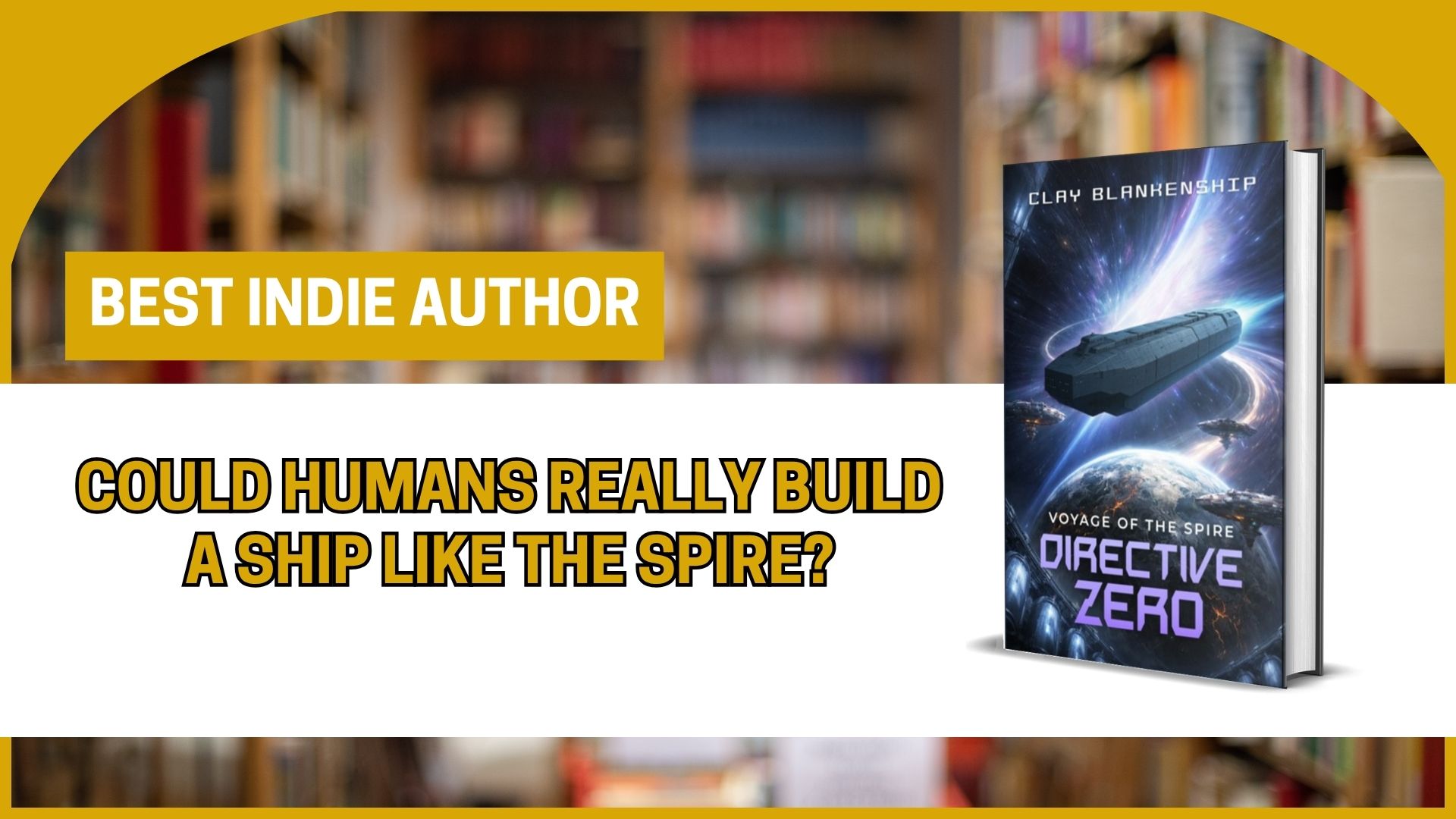
For centuries, humanity has looked toward the stars and imagined a future among them. From early astronomers studying distant worlds to modern space agencies planning missions beyond Earth, the dream of interstellar travel has remained one of our greatest ambitions. In Directive Zero: Voyage of the Spire, that dream becomes a reality through the creation of the Spire, a massive spacecraft designed not only to travel between stars but to carry the future of humanity with it.
The question is simple: could humans really build a ship like the Spire?
The answer depends on how we define possible. A vessel like the Spire would require technologies far beyond what exists today, but many of its challenges are based on real scientific problems that researchers are already exploring. The novel takes those concepts and imagines how they might evolve over the next century.
One of the greatest challenges would be keeping people alive during a journey lasting years or even generations. The Spire addresses this through advanced life support systems, agricultural decks, and closed loop environments designed to recycle essential resources. The idea of growing food aboard spacecraft is already being studied through experiments involving hydroponics, controlled environments, and sustainable biological systems. A true interstellar ship would need to become more than a vehicle. It would need to become a living world.
Artificial gravity is another major challenge. Long term exposure to low gravity can damage human health, affecting bones, muscles, and overall physical condition. In Directive Zero, the Spire uses Quantum Field Anchoring to create stable gravity without relying on traditional rotation. While this technology remains fictional, the problem it solves is very real. Future space exploration will require innovative solutions to help humans survive extended journeys.
The Spire’s Continuum Drive represents another leap into advanced technology. Current spacecraft cannot travel anywhere near the speed required for practical interstellar missions. However, scientists continue to explore theoretical concepts involving space time manipulation and advanced propulsion methods. The novel imagines a future where these ideas have moved from theory into engineering reality.
Beyond technology, the Spire also represents a social and ethical challenge. Building a spacecraft capable of carrying humanity into another star system would require global cooperation, enormous resources, and generations of planning. The ship would not only need engineers and scientists but also farmers, doctors, leaders, and communities capable of creating a functioning civilization away from Earth.
This is where Directive Zero: Voyage of the Spire becomes more than a story about a spacecraft. The Spire represents humanity’s ability to solve impossible problems when survival depends on it. It asks readers to consider whether the greatest challenge of reaching the stars is building the machine or becoming the kind of civilization worthy of the journey.
Humans may not be ready to build a ship exactly like the Spire today, but the questions behind its creation are already shaping the future. Every discovery, experiment, and exploration mission brings us closer to understanding what it would take to leave Earth behind.
The stars remain distant, but the dream of reaching them continues to inspire the next generation of builders, explorers, and storytellers.
Available Now On Amazon: https://a.co/d/04gI58wH