A culture does not preserve its deepest wisdom through facts alone. It carries its understanding of life through the stories people tell, the proverbs they repeat, the myths they inherit and the images they use to explain the world. These forms of expression help communities remember who they are, what they value and how they understand the human person.
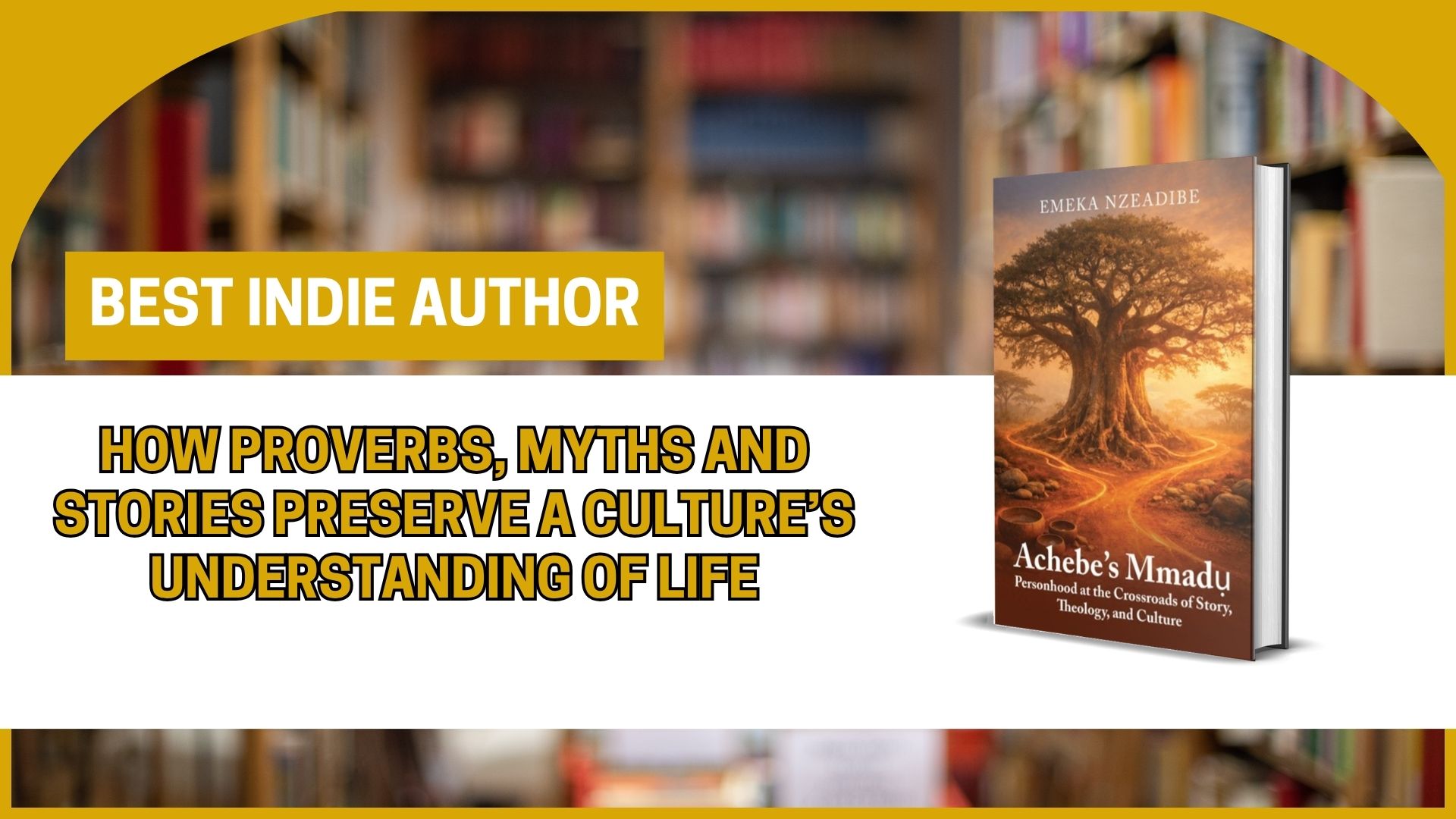
In Achebe’s Mmadụ: Personhood at the Crossroads of Story, Theology, and Culture, Emeka Nzeadibe explores how Chinua Achebe’s literary imagination gives voice to the philosophical and spiritual depth of Igbo culture. Rather than treating proverbs, myths and stories as decorative elements, the book shows how they function as vessels of memory, identity and personhood.
This is especially important in cultures where knowledge has long been transmitted through oral tradition. Proverbs condense generations of experience into memorable language. Myths provide frameworks for understanding creation, destiny, suffering, community and the divine. Stories place those ideas into human situations where readers can see how values are tested, challenged and transformed.
One Igbo saying central to Nzeadibe’s study is “Ife kwụlụ, ife akwụdebe ya,” which means that where something stands, something else stands beside it. The proverb expresses a worldview in which nothing exists completely alone. Human beings live within networks of relationships involving family, community, ancestors, nature, spiritual realities and God. Personhood is therefore not self-contained; it develops through connection, mutual recognition and responsibility.
Achebe’s stories bring this relational philosophy to life. In Things Fall Apart and Arrow of God, characters such as Okonkwo and Ezeulu are shaped by tradition, personal ambition, spiritual duty, social expectations and historical change. Their experiences reveal that a culture’s understanding of life cannot be reduced to simple rules. It must be explored through human complexity.
That complexity is one reason storytelling is so powerful. Achebe does not idealize Igbo society or present its people as flawless. Instead, he portrays individuals as neither perfect heroes nor one-dimensional villains. Their contradictions, failures, fears and hopes allow readers to encounter them as fully human. Through these narratives, culture becomes lived experience rather than abstract information.
Nzeadibe also connects storytelling to the concept of Mmadụ, the Igbo understanding of the human person. Mmadụ includes identity, consciousness, dignity, subjectivity and relationship with the surrounding world. In the book, storytelling becomes a means through which Mmadụ is expressed, protected and passed from one generation to another.
Proverbs and myths also resist cultural erasure. Colonial accounts often represented African societies as lacking philosophy, history, or civilization. Achebe challenged those distortions by placing Igbo language patterns, beliefs, rituals, institutions and moral debates at the center of his fiction. His stories allowed African people to appear as interpreters of their own world rather than objects described by outsiders.
This makes Achebe’s Mmadụ especially relevant today. Globalization can connect cultures, but it can also weaken local languages, memories and traditions. Nzeadibe reminds readers that preserving stories is not merely about protecting the past. It is about sustaining ways of understanding dignity, belonging, responsibility and human life.
Through proverbs, myths and narratives, a culture continues to speak. Emeka Nzeadibe’s book shows that when those voices are heard carefully, they can enrich not only one community’s understanding of humanity, but the wider human conversation.
Read the book on Amazon: https://a.co/d/0363OG8A