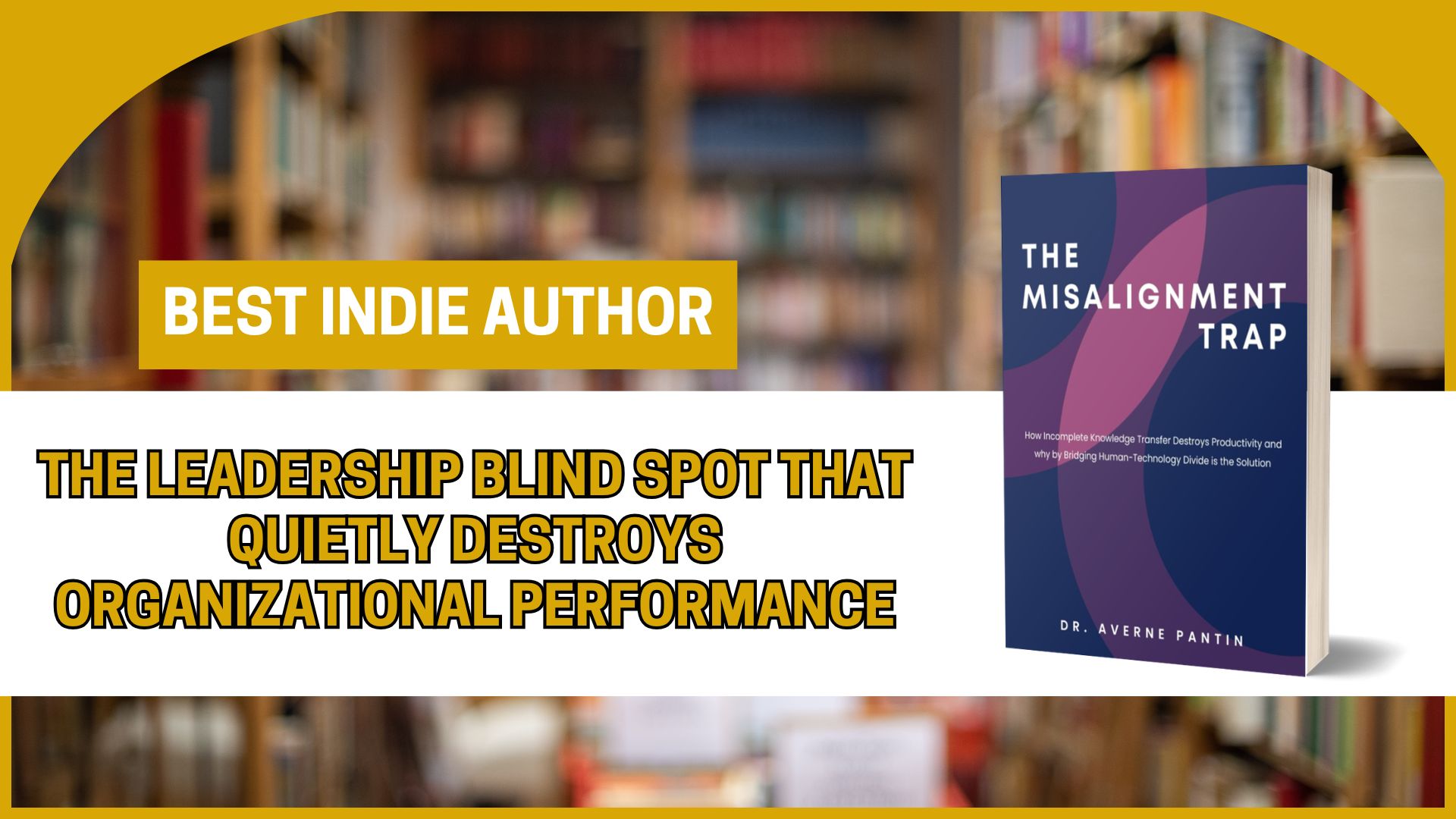
Most organizational failures are not sudden. They do not begin with dramatic collapse, public crisis or obvious mismanagement. Instead, they begin quietly inside leadership assumptions that appear reasonable, even responsible, but gradually disconnect organizations from the realities of how people actually learn, absorb and execute change. This hidden failure point is what The Misalignment Trap by Dr. Averne A. Pantin identifies as one of the most dangerous forces in modern transformation: the leadership blind spot in absorptive capacity.
Across more than three decades of global experience in manufacturing, logistics and institutional reform, Dr. Pantin observed a consistent pattern. Organizations invest heavily in new technologies, systems and modernization programs, yet performance often declines rather than improves. The equipment works. The software functions. The dashboards display data. But execution falters, productivity weakens and confusion spreads through operational layers. The cause is rarely technical. It is almost always a leadership oversight in how learning is structured and sustained.
This is the essence of the misalignment trap: leaders assume that once technology is installed, transformation has occurred. In reality, installation is only the beginning. Without sufficient knowledge transfer, continuity and reinforcement, systems remain externally imposed rather than internally understood. Employees are expected to perform within environments they have not fully absorbed. Over time, this creates a widening gap between leadership expectations and operational reality.
Dr. Pantin’s research, supported by quantitative analysis across multiple industrial sectors, demonstrates that leadership decisions are one of the strongest predictors of whether technology succeeds or fails. In particular, leadership impatience, the pressure to show immediate results, often leads to shortened training cycles, reduced learning reinforcement and premature declarations of success. What appears as progress on paper becomes fragile in practice.
The leadership blind spot emerges because early indicators are misleading. In the initial stages of implementation, performance metrics may improve. Systems are active, teams are engaged and outputs appear stable. Leaders interpret this as confirmation that transformation is working. However, beneath this surface, absorptive capacity remains incomplete. Employees may be following procedures without fully understanding them. This creates what Dr. Pantin describes as performance without comprehension, a condition where systems function mechanically but lack adaptive intelligence.
As time progresses, the consequences of this blind spot become visible. Employees begin encountering problems they are not equipped to solve. Workarounds replace structured understanding. Departments operate in silos, interpret data differently and respond inconsistently. Meetings become repetitive discussions without resolution. Eventually, inefficiency is normalized and reduced performance is accepted as the new baseline.
What makes this leadership failure particularly dangerous is its invisibility. Because systems continue to operate, leaders often assume stability. But operational continuity is not the same as organizational health. Dr. Pantin’s findings show that many institutions are not collapsing; they are drifting, slowly losing alignment between capability and expectation without recognizing the erosion in real time.
At the core of this issue is a misunderstanding of what leadership must manage in a digital and automated world. Traditional leadership models focus on strategy, resources and execution speed. However, The Misalignment Trap argues that modern leadership must also manage the rhythm and synchronization between learning and technological change. When leaders fail to protect this rhythm, organizations experience what the book defines as translational fatigue: a state where teams are still expected to operate advanced systems but no longer feel confident in their mastery.
The consequences extend beyond productivity. Employees in misaligned systems often experience reduced confidence, increased stress and disengagement. Innovation declines because experimentation feels unsafe. Over time, organizations shift from learning cultures to coping cultures. Leaders may not see this transformation directly, but its effects are evident in rising costs, declining efficiency and a reliance on external expertise.
Dr. Pantin’s work emphasizes that this blind spot is not a matter of intelligence or intent; it is a matter of structure. Leaders are often focused on outcomes, while the conditions required to sustain those outcomes, such as learning continuity, knowledge retention and absorptive capacity, are assumed rather than built. This assumption is the root of misalignment.
The solution, as outlined in The Misalignment Trap, requires a fundamental shift in leadership thinking. Technology must no longer be treated as a standalone investment, but as part of a broader learning ecosystem. Training must be continuous, not episodic. Leadership continuity must be preserved as a strategic asset. And most importantly, absorptive capacity must be measured, managed and protected with the same seriousness as financial performance.
Ultimately, the leadership blind spot is not about ignoring technology; it is about underestimating the human system required to sustain it. Dr. Pantin’s research reveals that organizations do not fail because they lack tools, but because they lack alignment between tools and understanding.
In a world defined by accelerating digital transformation, this insight is increasingly critical. The organizations that will thrive are not those that adopt technology fastest, but those whose leaders ensure that learning keeps pace with change. As The Misalignment Trap makes clear, leadership success is no longer defined by what is implemented, but by what is truly understood and sustained.