Hope is often treated like a feeling.
Something soft. Abstract. Optional.
But what if hope is actually biological?
What if, in your worst moment when your mind is racing, your chest is tight and everything feels like it’s collapsing, hope isn’t something you have to find?
What if it’s something you can activate?
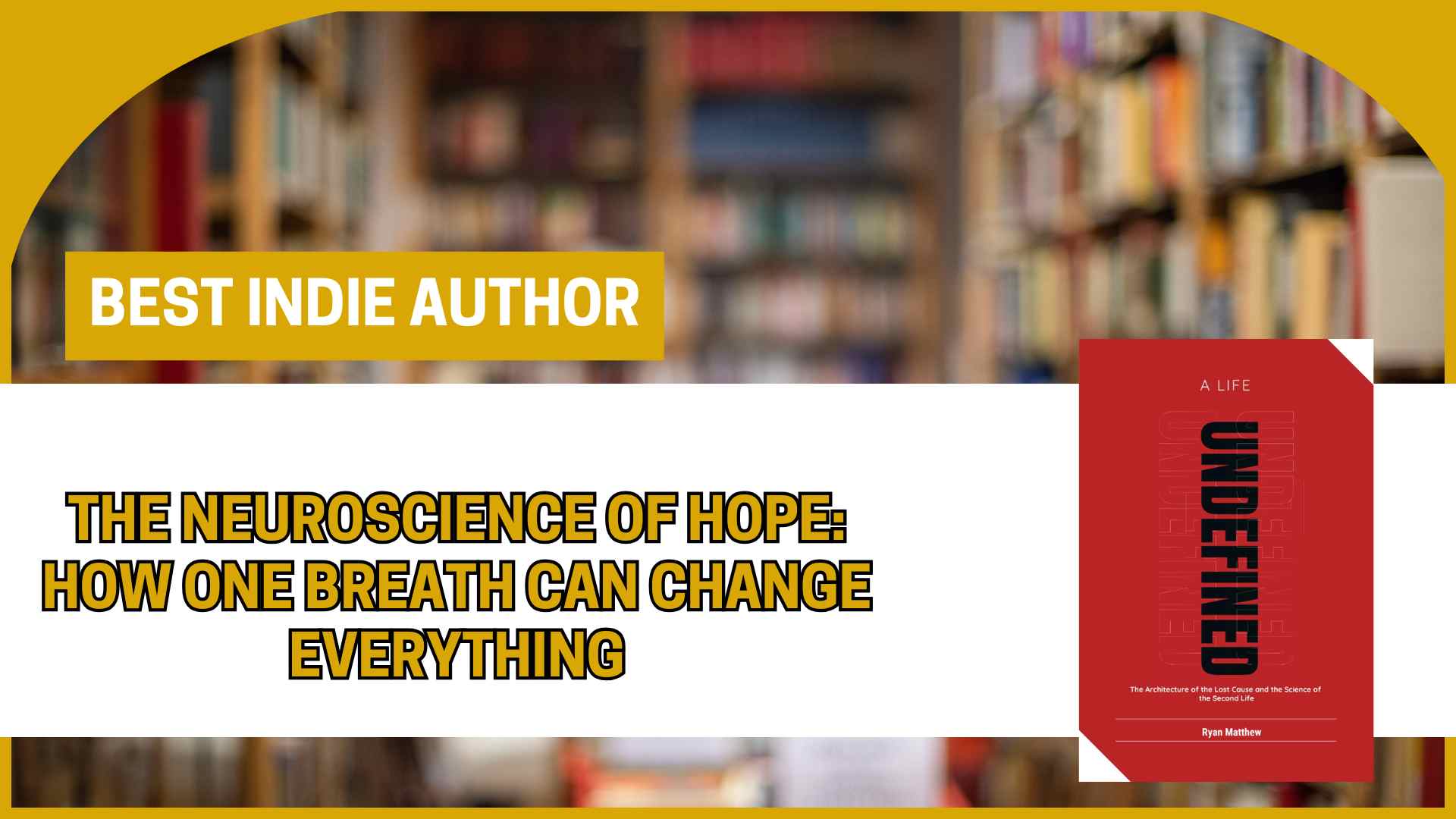
In A Life Undefined: The Architecture of the Lost Cause and the Science of the Second Life, Ryan Matthew explores a powerful idea: that even in the depths of crisis, the human body is wired for recovery. Not someday. Not eventually. But in real time.
And it can start with something as simple as a single breath.
When we experience stress, trauma or overwhelming pressure, the brain shifts into survival mode. The amygdala, the part responsible for detecting threats, takes control. Heart rate increases. Breathing becomes shallow. The body prepares to fight, flee or shut down.
In that state, clear thinking disappears.
This is where many people are labeled as “breaking down.” But from a neurological perspective, what’s actually happening is overload. The system isn’t failing; it’s doing exactly what it was designed to do under extreme pressure.
The problem is, most people don’t know how to interrupt it.
That’s where the breath comes in.
Deep, controlled breathing activates the vagus nerve, a critical part of the body’s parasympathetic nervous system. This is the system responsible for calming the body down, slowing the heart rate and restoring a sense of balance.
In other words, one intentional breath can begin to reverse the entire stress response.
It sounds simple. Almost too simple.
But it’s not.
It’s science.
And more importantly, it’s control.
In moments where everything feels out of control, the breath becomes a point of access, a way to manually shift your internal state when your mind alone can’t do it.
This is one of the core ideas Matthew introduces through his “BREATHE” framework in A Life Undefined. It’s not just about breathing, it’s about using that moment to reset your thinking, your behavior and your sense of identity.
Because here’s the deeper truth:
Hope isn’t just about feeling better.
It’s about regaining agency.
When you take that breath, you’re not just calming your body; you’re interrupting the narrative that says, “This is the end.” You’re creating space between the stimulus and your response. And in that space, something powerful happens:
Choice returns.
You can choose to pause instead of react.
You can choose to assess instead of assume.
You can choose to move forward instead of shut down.
This is the beginning of what Matthew calls the “Second Life.”
Not a dramatic restart, but a series of small, controlled shifts that move you out of survival mode and back into authorship. It doesn’t require perfect conditions. It doesn’t require you to have everything figured out.
It starts with one breath.
And then another.
The concept challenges one of the most damaging beliefs we hold that people who struggle in high-stress moments are weak or incapable. In reality, they’re often stuck in a physiological loop that they were never taught how to exit.
A Life Undefined reframes that experience. It replaces judgment with understanding and helplessness with tools.
Because when you understand how your system works, you stop seeing yourself as the problem.
You start seeing yourself as something else entirely:
A system capable of recovery.
So the next time everything feels like too much when your thoughts spiral and your body tightens, remember this:
Hope isn’t out there somewhere waiting for you.
It’s already inside you.
Waiting for a signal.
Waiting for a breath.
And that one breath might be the moment everything begins to change.
Available On Amazon: https://www.amazon.com/dp/B0H1GXHFVL/