Some people accept the world as it is. Others look at every obstacle, outdated system and difficult circumstance and ask a simple but powerful question: Is there a better way?
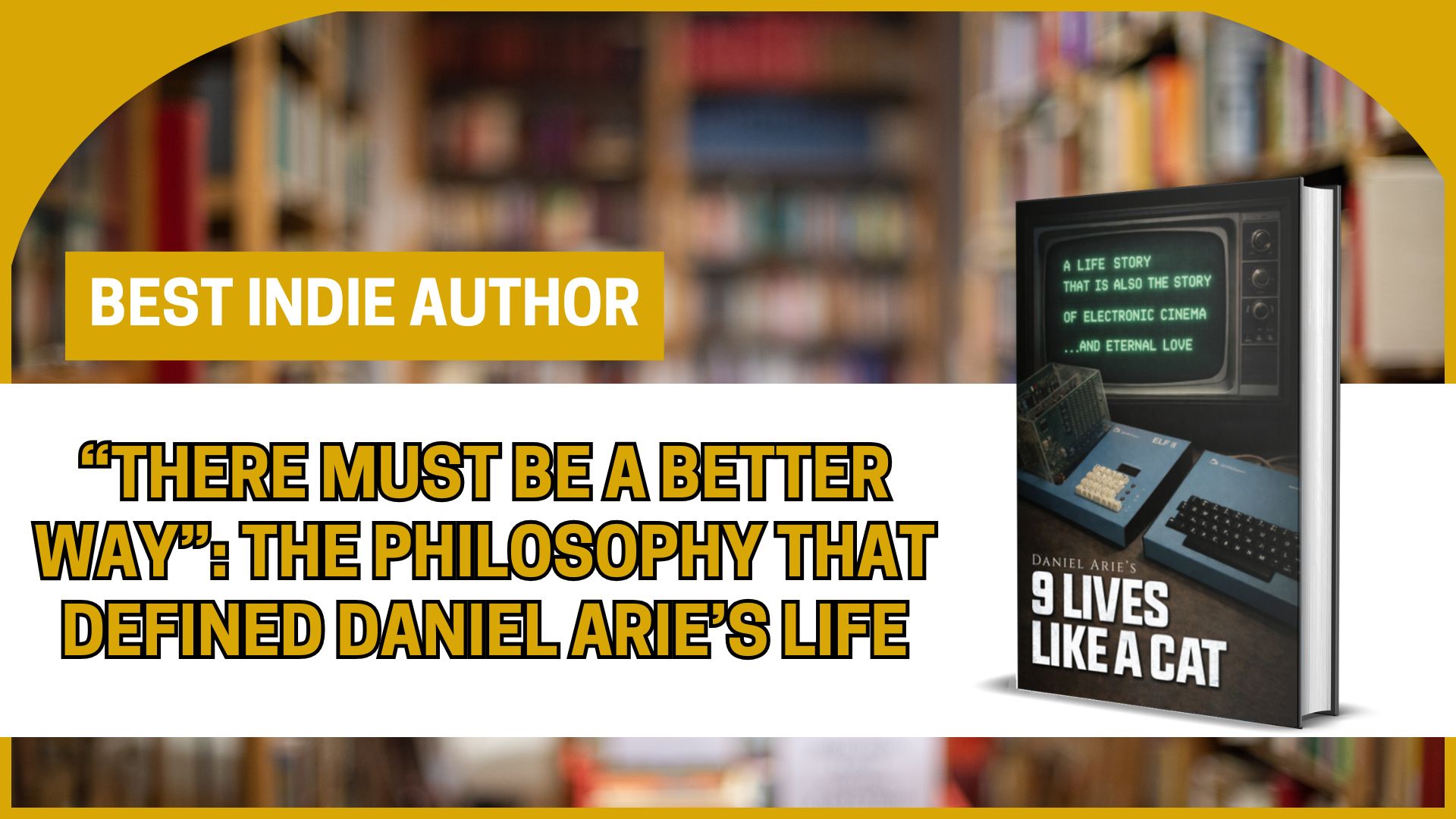
That question became a guiding philosophy for Daniel Arie, whose extraordinary memoir, 9 Lives Like a Cat: A Life Story That Is Also the Story of Electronic Cinema … and Eternal Love, follows a lifetime of reinvention, innovation, migration and emotional discovery. Throughout the book, Arie repeatedly finds himself facing problems without obvious solutions. Rather than surrendering to them, he studies, experiments, adapts and begins again.
His story starts in Communist Romania, where uncertainty entered his life at an early age. When Arie was three, his parents secretly left the country, leaving him and his brother with their grandparents. He grew up under a political system that restricted movement, discouraged dissent and closely watched anyone considered unconventional.
Yet Arie remained curious and rebellious. He developed an interest in physics, literature, electronics, sound recording and cinema. After studying at the Technical School for Cinematography, he began working at the Buftea film studios. Even when assigned technical responsibilities, he did not see himself as someone merely operating equipment. He was learning cinema, examining how every part of the production process worked and searching for ways to improve it.
Political pressure eventually pushed him out of Romania. He traveled through Paris before joining his family in Argentina, where he had to learn Spanish, repair electronic equipment and rebuild his life. Later, he moved to Canada and once again started from almost nothing. These transitions form the “nine lives” of the title: new beginnings created by circumstances, courage and Arie’s refusal to remain trapped by failure.
His “better way” philosophy became especially important during his career in Canadian film and television. Arie entered the industry when editors still physically cut celluloid and audio recordings lost quality with every copied generation. Television commercials could also look different when broadcast than they had in the screening room.
Instead of accepting these limitations, Arie explored emerging technologies. He built equipment, studied electronic publications, attended industry conferences, learned computer programming and experimented with video-based editing. Using an ELF II home computer and programs written in BASIC, he developed methods for translating video time code into the feet-and-frames measurements used in film. His work helped connect traditional filmmaking with the developing world of electronic post-production.
Arie also introduced digital sound into his editing process, allowing editors to synchronize and manipulate audio without the distortion associated with repeated magnetic copying. Advertising agencies soon adopted the technique and other facilities equipped themselves to follow the new workflow.
However, 9 Lives Like a Cat is not only about finding better technology. It is also about searching for a better life. Arie survives displacement, professional setbacks, failed relationships, business difficulties and years of separation from Nelly, the childhood companion who remained deeply connected to his emotional world.
Their eventual reunion demonstrates that reinvention does not always require abandoning the past. Sometimes, a better way forward means returning to something meaningful that time never completely erased.
Daniel Arie’s memoir celebrates the people who question limitations and refuse to believe that the current method must be the final one. His life shows that curiosity can become a survival skill, innovation can grow from frustration and even after disappointment, another beginning may still be waiting.
For readers drawn to memoirs about technology, cinema, immigration, resilience and enduring love, 9 Lives Like a Cat offers an inspiring reminder: there may always be a better way.