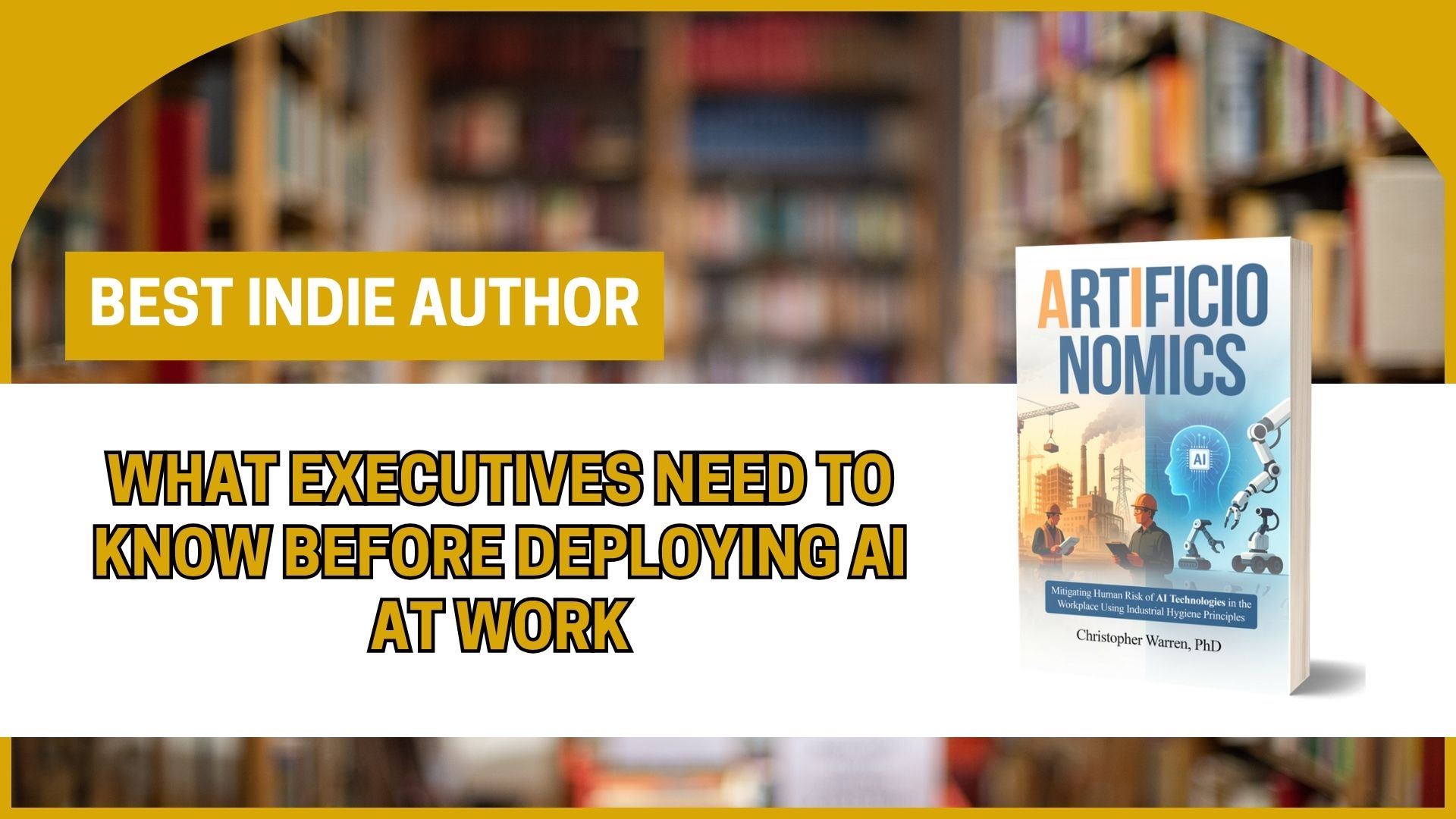
Artificial intelligence is becoming one of the most powerful forces in the modern workplace. It can help companies automate routine tasks, improve decision-making, increase productivity, monitor safety conditions and reduce exposure to certain hazards. For executives, the appeal is clear. AI promises speed, efficiency and competitive advantage. Yet before any organization deploys AI at scale, leaders must ask a more important question: how will this technology affect the people who work with it every day?
This is the central concern of ArtificIonomics: Mitigating Human Risk of AI Technologies in the Workplace Using Industrial Hygiene Principles by Christopher Warren, PhD. The book presents a timely and practical framework for executives who want to adopt AI responsibly while protecting worker health, safety, dignity and trust.
Many leaders view AI as a technology issue. Dr. Warren challenges that narrow view. He shows that AI is also a workplace safety issue, a governance issue, an ethics issue and a human performance issue. When AI systems are introduced without proper planning, they can create risks that are easy to miss at first. Employees may experience stress from constant digital monitoring, anxiety about job displacement, cognitive fatigue from machine-paced workflows or frustration when algorithmic decisions are unclear or unfair.
Executives must understand that AI risk is not limited to system failure. A tool can function exactly as designed and still harm morale, privacy, autonomy or psychological safety. For example, an AI productivity tracker may help managers measure output, but it may also make employees feel watched and distrusted. An automated scheduling system may optimize staffing, but it may also disrupt work-life balance. A hiring algorithm may speed up recruitment, but it may also reproduce bias if it is trained on flawed data.
ArtificIonomics gives leaders a structured way to think about these concerns before they become larger organizational problems. Drawing from industrial hygiene principles, the book encourages businesses to identify AI-related hazards, evaluate worker exposure and control risks through thoughtful safeguards. This approach moves executives beyond reactive problem-solving and into proactive risk prevention.
Before deploying AI, leaders should ask whether the system is truly necessary, whether a less intrusive option is available and whether workers understand how the technology will affect their roles. They should also ensure that safety professionals, HR teams, legal advisors, technology experts and frontline employees are included in the decision-making process. AI should not be introduced in isolation by technical teams alone. It should be reviewed through the lens of human impact.
Dr. Warren also emphasizes the importance of training and transparency. Workers need more than a short software demonstration. They need AI literacy, clear policies, reporting channels and confidence that human judgment still matters. When employees know how AI is being used and why, they are more likely to trust the process. When they feel excluded, uncertainty can quickly turn into resistance.
What makes ArtificIonomics especially valuable is its balanced message. The book does not tell executives to fear AI. Instead, it shows them how to lead with responsibility. AI can improve safety, reduce dangerous work, support better decisions and strengthen operations. However, those benefits are only sustainable when organizations protect the people behind the performance data.
For executives preparing to bring AI into the workplace, ArtificIonomics is a necessary guide. Christopher Warren, PhD offers a clear reminder that responsible innovation is not only about what technology can achieve. It is also about what leadership chooses to protect.
In the age of AI, the strongest companies will not be the ones that automate the fastest. They will be the ones that innovate wisely, govern transparently and keep human well-being at the center of progress.