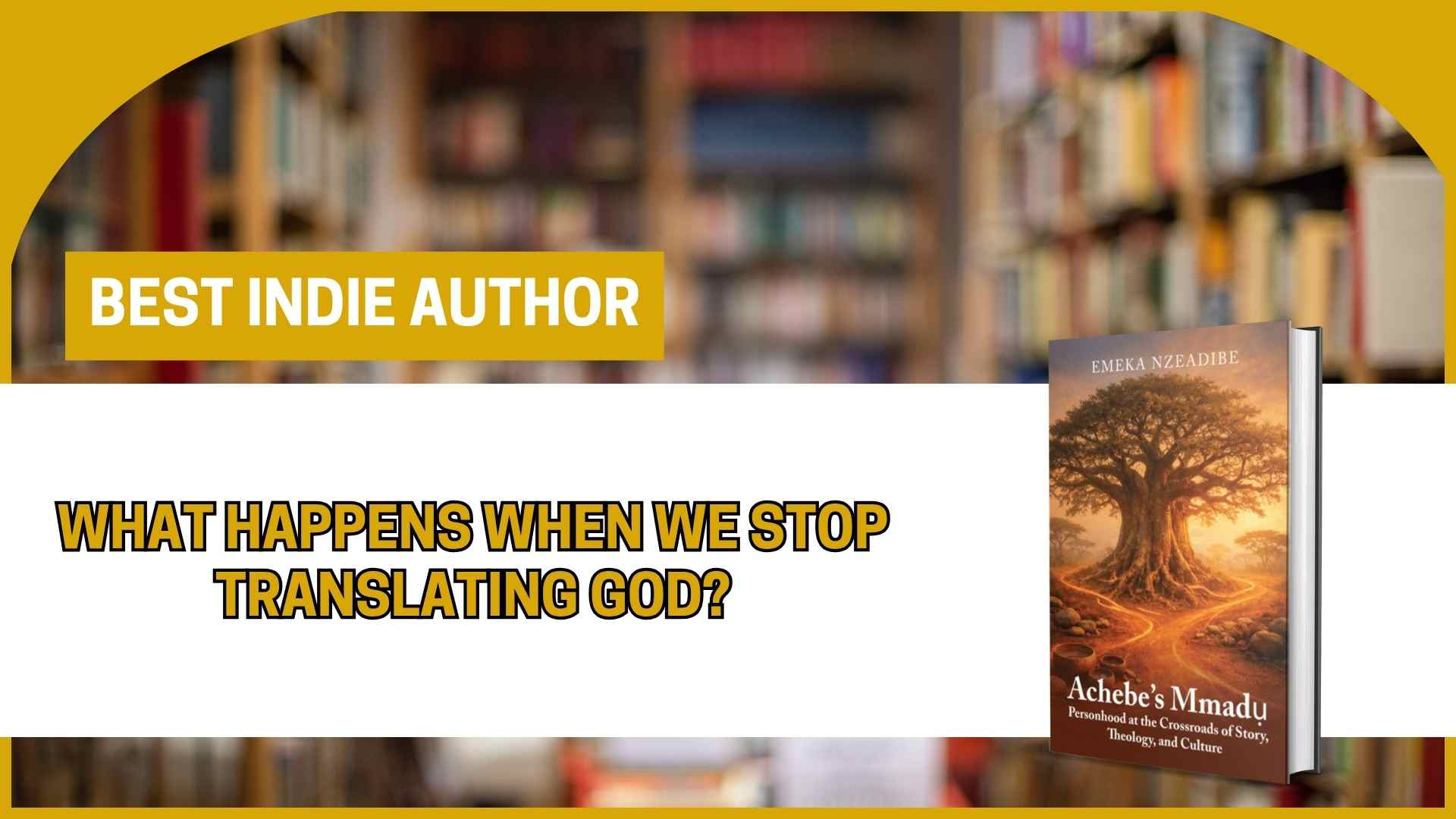
When Western Christian missionaries arrived in West Africa, they brought with them more than just a new religious paradigm. They brought an entirely foreign linguistic and metaphysical blueprint and looked at a rich, highly sophisticated spiritual landscape and immediately began forcing it into Western conceptual boxes. In his book Achebe’s Mmadụ, Emeka Nzeadibe provides a masterclass in analyzing the profound linguistic barriers of translation that occurred during this historical and colonial encounter. By aggressively mapping European theological constructs onto indigenous languages, centuries of nuanced philosophical thought were flattened into simplistic, Western-friendly terms.
As per this book, we get to learn that language is the lens through which we perceive reality. When we stop translating indigenous spiritualities into Western terminology and honor the original language, our entire metaphysical horizon expands, which can lead to more coincidences, spirituality, and peace.
Here are 8 critical reasons why stopping this translation matters and how Western frameworks fundamentally misread the Igbo worldview:
- 1. The Flattening of Chukwu: Missionaries translated Chukwu simply as the Western, anthropomorphic concept of “God,” missing that Chukwu represents the infinite, supreme source of all cosmic being, operating completely outside of patriarchal, European imagery.
- 2. The Distortion of Chi: The deeply nuanced, metaphysical concept of Chi—an individual’s unique life force, divine spark, and spiritual destiny—was incorrectly reduced to the simplistic Western trope of a “guardian angel” or a deterministic, fatalistic trap.
- 3. Misunderstanding ‘Sin’ as Ajo Mma: Western concepts of original sin, moral stain, and inherited guilt were clumsily mapped onto Ajo Mma or Alu (abomination). In Igbo cosmology, these terms do not signify abstract, legalistic offenses against a distant deity, but rather specific, tangible actions that disrupt the vital balance of the community and the earth, requiring communal restoration rather than private penance.
- 4. Imposing the ‘Soul’ Split: The inherently holistic human spirit was violently fractured to fit into the classic Western dualism of a mortal, inherently flawed body versus an immortal, disembodied soul, disrupting a unified understanding of personhood.
- 5. Erasing Non-Gendered Divinity: Language dictates our metaphysical boundaries; while Western theology heavily relied on gendered, patriarchal pronouns (“He,” “Father”), indigenous linguistic reclamation highlights non-gendered spiritual structures where the divine cannot be contained by human gender.
- 6. Displacing Sacred Spaces: By mapping spiritual value almost exclusively onto a physical church building, translation eroded the profound understanding that the natural earth itself, the ancestral ground, and the active community are inherently sacred spaces.
- 7. The Loss of Dialogue: Translating with an attitude of absolute theological exclusivity replaced the traditional, open, and relational dialogue of Igbo multitheism with rigid, uncompromising dogmatic binaries.
- 8. Creating Spiritual Epistemicide: Forcing an entire culture to abandon its native metaphysical vocabulary systematically cut people off from their ancestral frameworks for navigating suffering, celebrating joy, and understanding human purpose.
To truly comprehend how language shapes the very contours of the human soul and to explore the urgent necessity of indigenous linguistic reclamation in modern philosophy, you absolutely must read Achebe’s Mmadụ. It stands as an eye-opening, essential journey into reclaiming profound cosmic truths that translation very nearly erased from history.
Get your copy today! https://www.amazon.com/dp/B0GZFB5P25/