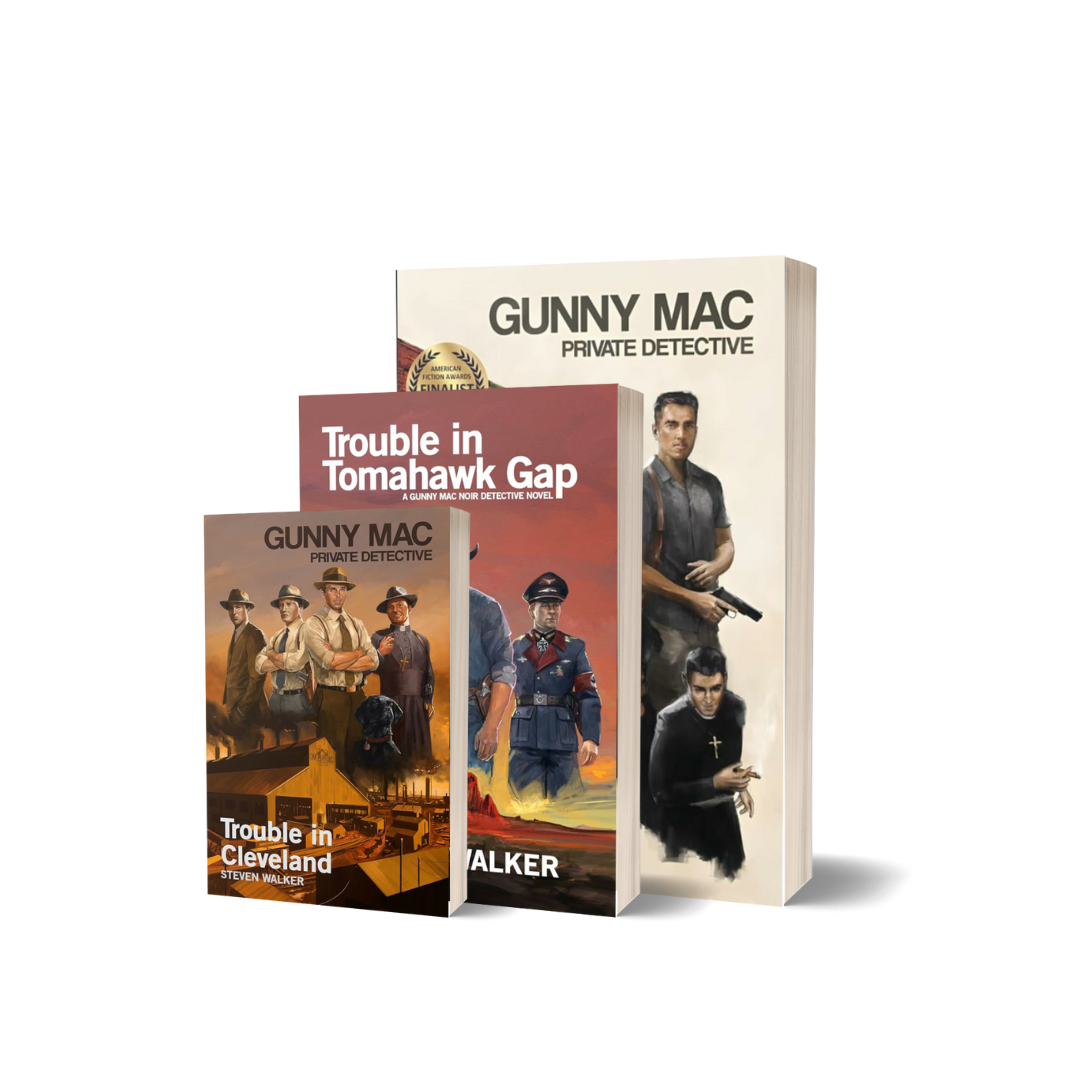
There is something about World War II that feels inseparable from the noir storytelling genre. Long before the term PTSD entered the common language, the war produced a generation of men and women carrying invisible wounds. Cities were darker, trust was fragile, and morality rarely came in clean lines. Noir fiction thrives in precisely that kind of world. It is why World War II remains one of the most powerful backdrops for detective fiction, as seen in the Gunny Mac Private Detective series by Steven G. Walker.
At its core, noir is about broken ideals. The hardboiled detective is not chasing glory. He is chasing truth in a world that no longer pretends to be fair. World War II magnified this tension. Nations spoke in the language of honor and sacrifice, yet ordinary people lived with rationing, corruption, black markets, and quiet desperation. Soldiers returned home changed, often expected to resume civilian life without question. That emotional dislocation is fertile ground for noir.
In Gunny Mac Private Detective: Trouble in Chinatown, readers meet Gunny Mac as a Marine veteran of the Battle of Guadalcanal, who has survived unimaginable violence. Honolulu’s Chinatown is where Mac first learns the score. The war pumps money into the islands like blood squirting through an artery, and every hustler with a pulse wants a piece. The cops look the other way when it’s convenient, the military looks the other way when it’s profitable, and the crooks don’t look away at all. They watch. They wait. They know a Marine with scars is either trouble or opportunity.
Mac operates in the shadows where patriotism and profit collide. His investigative work reflects the central noir question. How do you do the right thing when the system itself is compromised?
World War II also blurred the line between criminal activity and survival. Smuggling, theft, and corruption were often rationalized as necessary evils. Noir fiction has always examined that gray space. In Gunny Mac Private Detective: Trouble in Cleveland, Steven G. Walker further develops this theme by shifting the setting to an industrial American city crucial to the war effort. It’s 1943, and Cleveland is the crown jewel East of the Mississippi River, where gangsters and the Hollywood elite hang out; Carnegie and Rockefeller welcome them with open arms; factories run day and night; labor tensions simmer; and organized crime exploits opportunities wherever they appear. When a factory bombing and a priest’s murder pull Gunny Mac into a complex investigation, the story exposes how wartime urgency can be used to justify terrible acts. Noir thrives on that contradiction. Good intentions do not always produce good outcomes.
What makes World War II especially effective for noir storytelling is the way it reshaped personal identity. Soldiers were trained to act decisively and violently, then expected to return to civilian restraint. Gunny Mac embodies that conflict. His Marine instincts never shut off. They adapt to detective work. He notices what others miss because he learned survival in combat. Noir detectives are often outsiders, and veterans of World War II were outsiders even in their own hometowns.
The series reaches its most morally complex expression in Trouble in Tomahawk Gap: A Gunny Mac Noir Detective Novel. Here, the noir lens expands beyond crime to encompass espionage and national security. Nazi infiltration, Japanese internment camps, and the targeting of a Navajo Marine hero reveal how fear corrodes justice. Noir has constantly confronted systems that claim moral authority while committing quiet cruelty. World War II America was no exception. This novel shows how even righteous wars produce men whose morality lives in the shadows.
For readers who love crime fiction, World War II offers stakes that feel immediate and consequential. A detective’s failure can cost lives, derail the war effort, or destroy communities already under strain. For history enthusiasts, noir provides a deeply human entry point into the era. Instead of generals and battle maps, readers experience history through streets, factories, back rooms, and private grief.
Steven G. Walker understands that noir is not about stylish cynicism. It is about people trying to hold onto integrity when the world keeps demanding compromise. World War II created a reality where those compromises were constant. That is why the era and the genre fit together like a .45 in a shoulder holster and naturally with Steven G. Walker’s novels.
Read his books now:
Gunny Mac Private Detective: Trouble in Chinatown: Gunny Mac Private Detective: Trouble in Chinatown .
Gunny Mac Private Detective: Trouble in Cleveland: Gunny Mac Private Detective: Trouble in Cleveland .
Trouble in Tomahawk Gap: A Gunny Mac Noir Detective Novel: Trouble in Tomahawk Gap: A Gunny Mac Noir Detective Novel (Gunny Mac Private Detective) .