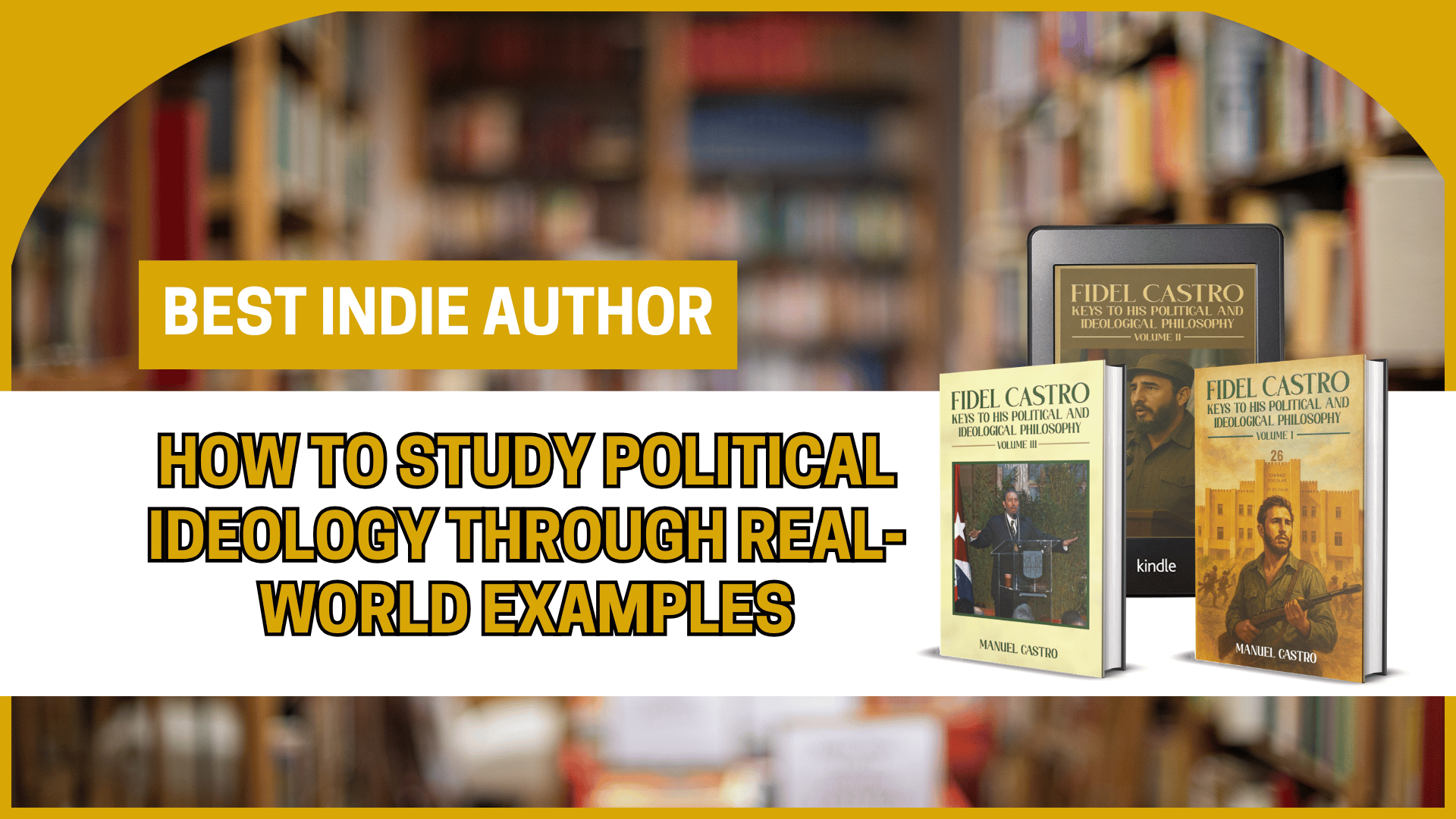
Studying political ideology can often feel abstract and overwhelming. Concepts like socialism, nationalism and sovereignty are frequently explained through theory-heavy texts that can be difficult to connect with real life. For students and readers who want a clearer, more practical understanding, the key lies in exploring ideology through real-world examples. This is exactly what Fidel Castro: Keys to His Political and Ideological Philosophy by Manuel A. Castro offers: a structured and insightful way to understand political thought through lived experience and historical application.
At the center of this approach is the philosophy and leadership of Fidel Castro, whose ideas were not just theoretical constructs but guiding principles implemented over decades. By analyzing his speeches, decisions and policies, the series provides a unique opportunity to see how political ideology functions in practice. Instead of simply defining concepts, the books demonstrate how those concepts influence actions, shape institutions and drive long-term change.
One of the biggest challenges in studying political ideology is bridging the gap between theory and application. Many learners struggle to understand how abstract ideas translate into real-world outcomes. This series addresses that challenge by organizing more than 300 key concepts into a cohesive framework. Each concept is grounded in historical context, making it easier for readers to see how ideas evolve and interact with social, economic and political realities.
For example, rather than presenting revolution as a vague or symbolic idea, the books explore it as a multidimensional process involving economic reform, cultural development and social transformation. This allows readers to understand not just what revolution means, but how it unfolds in practice. Similarly, concepts like sovereignty and international relations are examined through real-world scenarios, helping readers grasp their significance in shaping global dynamics.
Another advantage of learning through real-world examples is the development of critical thinking skills. When readers see how ideas are applied in different situations, they are better equipped to analyze outcomes, question assumptions and form their own perspectives. The series encourages this kind of engagement by presenting ideas in a way that invites interpretation and discussion, rather than simply delivering conclusions.
The role of communication also becomes clearer when ideology is studied in context. Fidel Castro was known for his ability to convey complex ideas in a way that resonated with diverse audiences. His speeches served as both educational tools and mobilization instruments, illustrating how language and messaging can shape public understanding and influence collective action. By examining this aspect of leadership, readers gain insight into the power of communication in political processes.
In addition to enhancing understanding, this approach makes studying political ideology more engaging. Real-world examples bring concepts to life, turning abstract ideas into tangible experiences. This not only improves comprehension but also makes the learning process more memorable and meaningful.
Fidel Castro: Keys to His Political and Ideological Philosophy is particularly valuable for students, researchers and anyone interested in political science or history. It provides a practical framework for studying ideology, combining theoretical depth with real-world relevance. Whether used for academic purposes or personal learning, the series offers a comprehensive guide to understanding how ideas shape societies.
In today’s complex and interconnected world, the ability to analyze political ideology is more important than ever. By focusing on real-world examples, readers can move beyond surface-level understanding and develop a deeper, more nuanced perspective.
Ultimately, this series shows that political ideology is not just something to be studied; it is something to be understood through action, context and experience.