What makes us truly human?
Is identity something we build alone through personal ambition and individual achievement? Or does humanity emerge through relationship, community, memory and spiritual belonging?
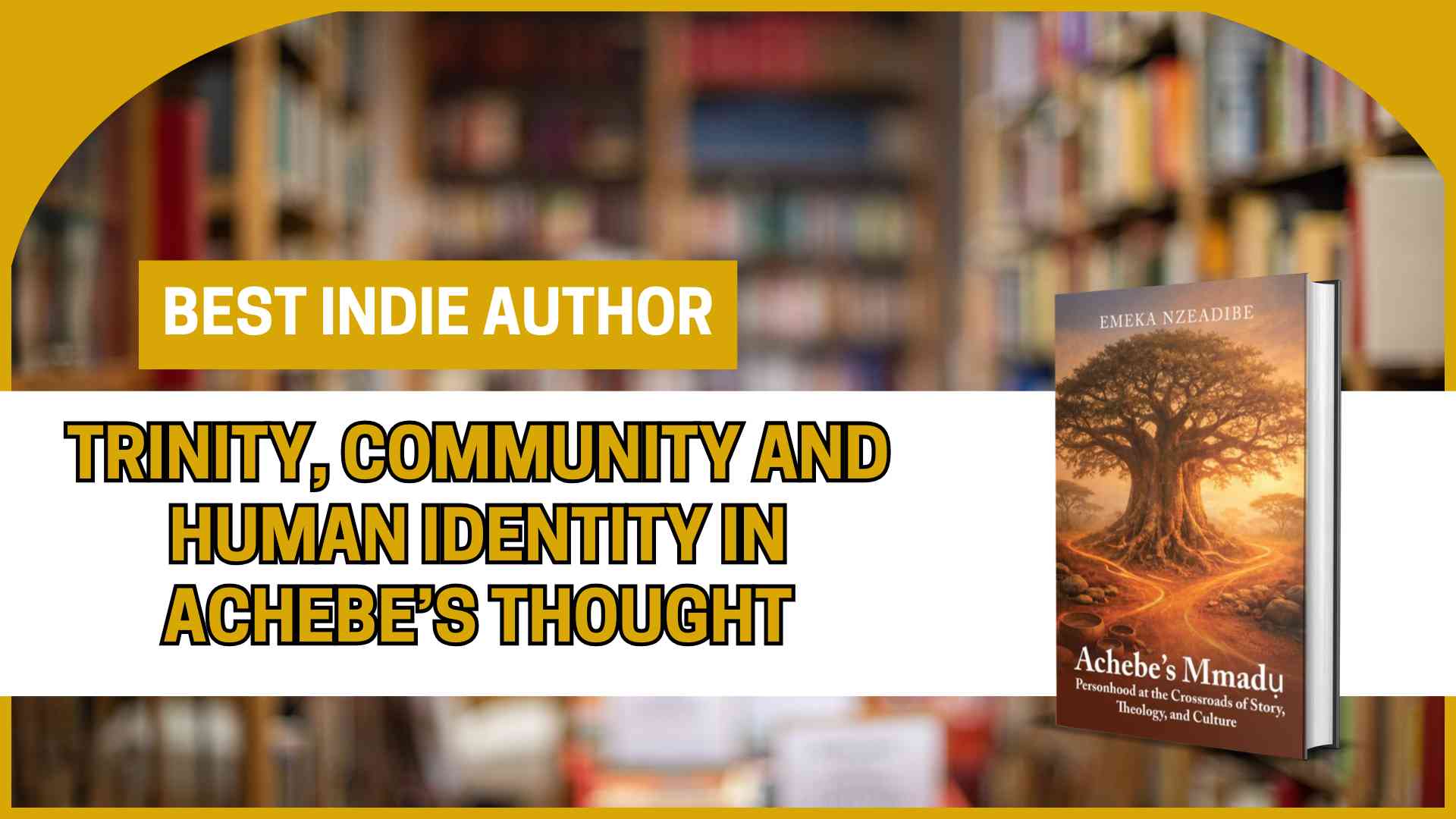
These questions lie at the heart of Achebe’s Mmadụ: Personhood at the Crossroads of Story, Theology, and Culture by Emeka Nzeadibe, a bold and original work that reexamines human identity through the literary and philosophical world of Chinua Achebe.
For many readers, Achebe is best known as the author of Things Fall Apart, the landmark novel that challenged colonial portrayals of Africa and restored dignity to African storytelling. But in Achebe’s Mmadụ, Nzeadibe argues that Achebe was doing something even deeper. Beneath the political and cultural dimensions of his fiction lies a profound theological and anthropological vision of what it means to be human.
At the center of this vision is the Igbo concept of Mmadụ personhood understood not as isolated individuality, but as relational existence.
In Achebe’s world, no person stands alone.
Identity is formed through bonds of family, ancestry, society, spirituality and shared responsibility. Human beings exist within a living network of relationships that connects the visible and invisible worlds. Community is not simply a social arrangement; it is part of the structure of existence itself.
This insight creates one of the book’s most fascinating theological conversations: the relationship between Igbo notions of personhood and the Christian understanding of the Trinity.
In Christian theology, the Trinity describes God as relational communion: Father, Son and Holy Spirit existing in eternal relationship. Divine life itself is understood not as a solitary existence but as an interconnected being. Relationship is not secondary to identity; relationship is identity.
Nzeadibe demonstrates that Achebe’s portrayal of Mmadụ resonates powerfully with this theological vision.
In Achebe’s Igbo cosmology, the human person becomes fully human through participation in community. Dignity is discovered through mutual recognition. Responsibility toward others is not optional but essential to personhood itself. One’s humanity is inseparable from the humanity of others.
This worldview stands in sharp contrast to the hyper-individualism that dominates much of modern culture. Today, identity is often framed around self-construction, independence, personal branding and individual success. The result, paradoxically, is widespread loneliness, fragmentation and loss of meaning.
Achebe’s thought offers another possibility.
Through stories, proverbs, rituals, communal life and spiritual consciousness, his works reveal a world where human beings belong to one another. The famous Igbo principle, echoed throughout Achebe’s writing, “Let the kite perch and let the eagle perch too,” captures this philosophy of coexistence and mutual flourishing.
In Achebe’s Mmadụ, Nzeadibe shows how this relational worldview extends beyond sociology into theology itself. Human identity reflects divine relationality. To be human is to exist in communion with neighbors, ancestors, creation and God.
The book’s exploration of Chi, the personal spiritual presence or destiny accompanying each individual, further deepens this understanding. Achebe’s well-known proverb, “When one says yes, one’s Chi says yes,” presents identity as both personal and relational. Human beings exercise agency, yet they do so within a larger spiritual and communal horizon.
What emerges is a remarkably rich African theological anthropology that challenges simplistic divisions between individual freedom and communal belonging.
More importantly, the book invites readers to rethink contemporary assumptions about humanity itself.
Can we recover a vision of personhood grounded not in competition but in relationship? Can identity be understood as participation rather than isolation? Can storytelling, culture and spiritual memory help restore fractured human communities?
These are the urgent questions Achebe’s Mmadụ places before modern readers.
Far more than a study of literature, the book becomes a conversation about human destiny, dignity and coexistence in a deeply divided world. By bringing Igbo cosmology into dialogue with Christian theology and global philosophical discourse, Nzeadibe offers a fresh and compelling contribution to discussions of identity, humanity and the future of communal life.
In a time marked by alienation and cultural fragmentation, Achebe’s Mmadụ reminds us that the human story has always been relational and that perhaps the deepest truth about being human is that we were never meant to stand alone.
Available On Amazon: https://www.amazon.com/dp/B0GZV57B1G/