
Some lives follow a clear path. Daniel Arie’s life repeatedly broke apart, crossed borders and began again.
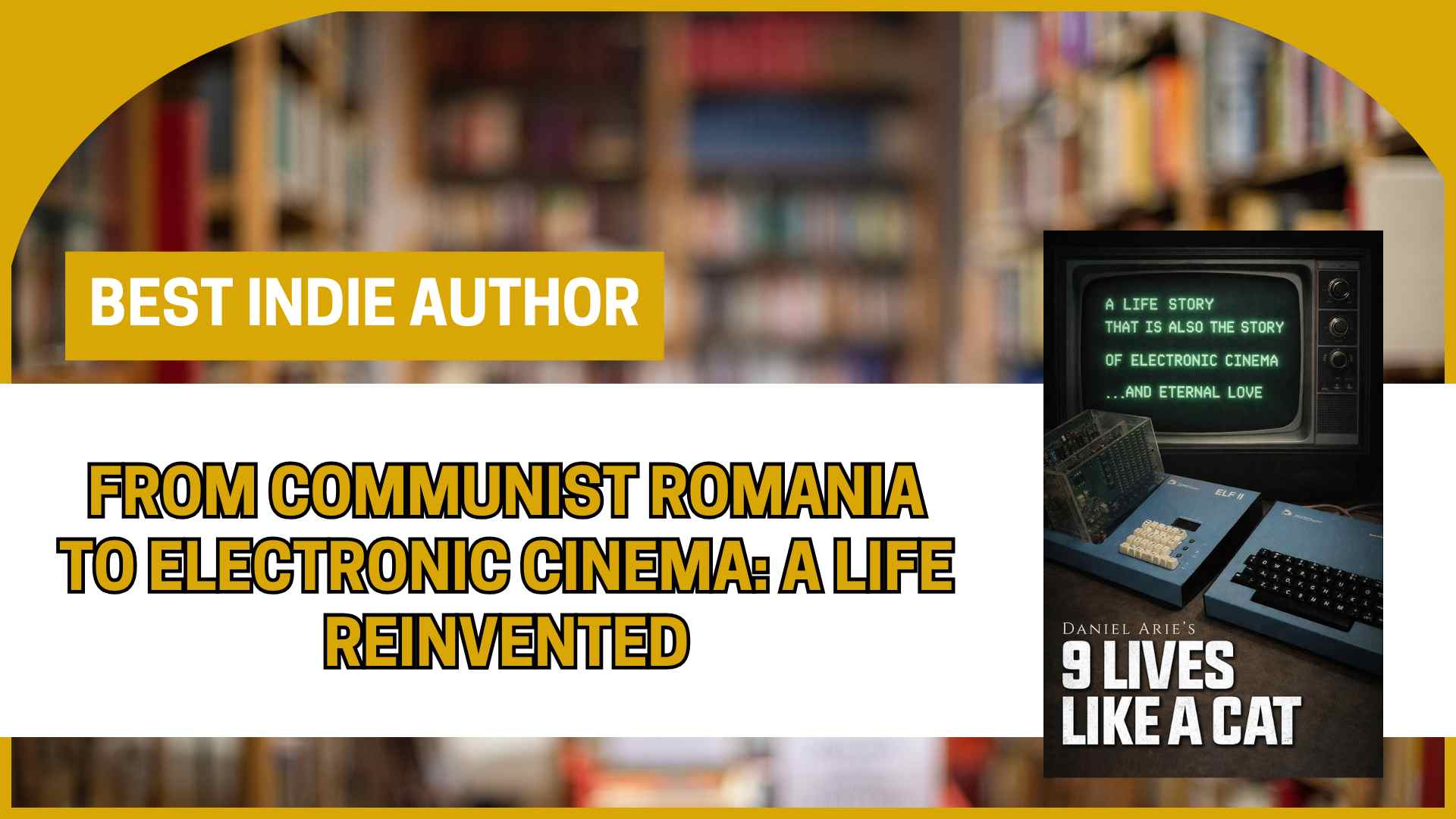
In 9 Lives Like a Cat: A Life Story That Is Also the Story of Electronic Cinema … and Eternal Love, Arie recounts an extraordinary journey from Communist Romania to the emerging world of electronic filmmaking. His memoir is not simply a record of places visited or jobs performed. It is the story of a man who learned to rebuild his identity whenever history, politics or technology changed the rules around him.
Arie grew up in postwar Bucharest after his parents secretly left Romania. Raised by his grandparents, he experienced the emotional uncertainty of separation alongside the pressures of an increasingly controlling Communist regime. His family’s home was divided by government authorities, political conformity shaped educational opportunities and even youthful rebellion could become part of an official record.
Yet cinema offered him another world.
At the Technical School for Cinematography, Arie studied lighting, sound recording, laboratory work and camera mechanics. He entered the Romanian film industry in 1963, working at the Buftea studios as a boom operator and later in recording and technical maintenance. Surrounded by sound stages, synchronizing machines and international productions, he began developing the combination of creative curiosity and technical problem-solving that would define his career.
His openness, however, also attracted the attention of the Securitate. Arie describes being detained and questioned over comments made in cafés and intellectual circles. Threatened with prosecution as an enemy of the state, he was offered another possibility: leave Romania and reunite with his family abroad.
On July 15, 1966, he boarded a plane for Paris. It was his first flight and the beginning of what he calls his second life. Even while the aircraft waited in Prague, he feared that an officer might board and return him to prison. When he finally arrived in Paris, the ordinary sights of Western life, including an escalator at Orly Airport, felt like evidence that he had entered a different reality.
Argentina came next. Reunited with a father he barely knew, Arie struggled with language, family expectations and disappointing work. He repaired chemical copying machines, worked briefly in a French bookstore and failed a test assembling transistor radios. But these apparent setbacks pushed him toward the electronics knowledge that would later become essential.
A position at the Grundig factory changed his direction. Arie discovered a talent for diagnosing faults in tape recorders, rebuilding machines and improving their sound. At the same time, screenings at the Canadian Embassy’s Cinematheque renewed his desire to return to filmmaking. Inspired by Canadian cinema and the work of filmmakers such as Michel Brault, he applied to immigrate to Canada.
When Arie arrived in Montreal in 1968, another life began. He initially repaired dictating machines and televisions, learning English as he worked. Gradually, he entered dubbing, sound editing, commercial production and film post-production.
Then his two worlds, cinema and electronics, came together.
Arie experimented with transferring film to videotape, synchronizing digital sound and using a home-built computer to convert video time codes into precise film measurements. His work helped create practical bridges between traditional celluloid editing and the electronic systems that would eventually reshape the industry.
The transformation was not immediate or universally welcomed. Traditional editors feared losing the texture and ritual of working with physical film. Arie understood their resistance, but he also saw that the future was already arriving.
That is the enduring appeal of 9 Lives Like a Cat. It shows reinvention not as a dramatic decision made once, but as a lifelong practice.
Daniel Arie escaped one system, adapted to several cultures and helped build another way of making cinema. His story reminds readers that a disrupted life is not necessarily a ruined one. Sometimes, it is the beginning of an entirely new future.
Available On Amazon: https://www.amazon.com/dp/B0H6R4ZVGK/


