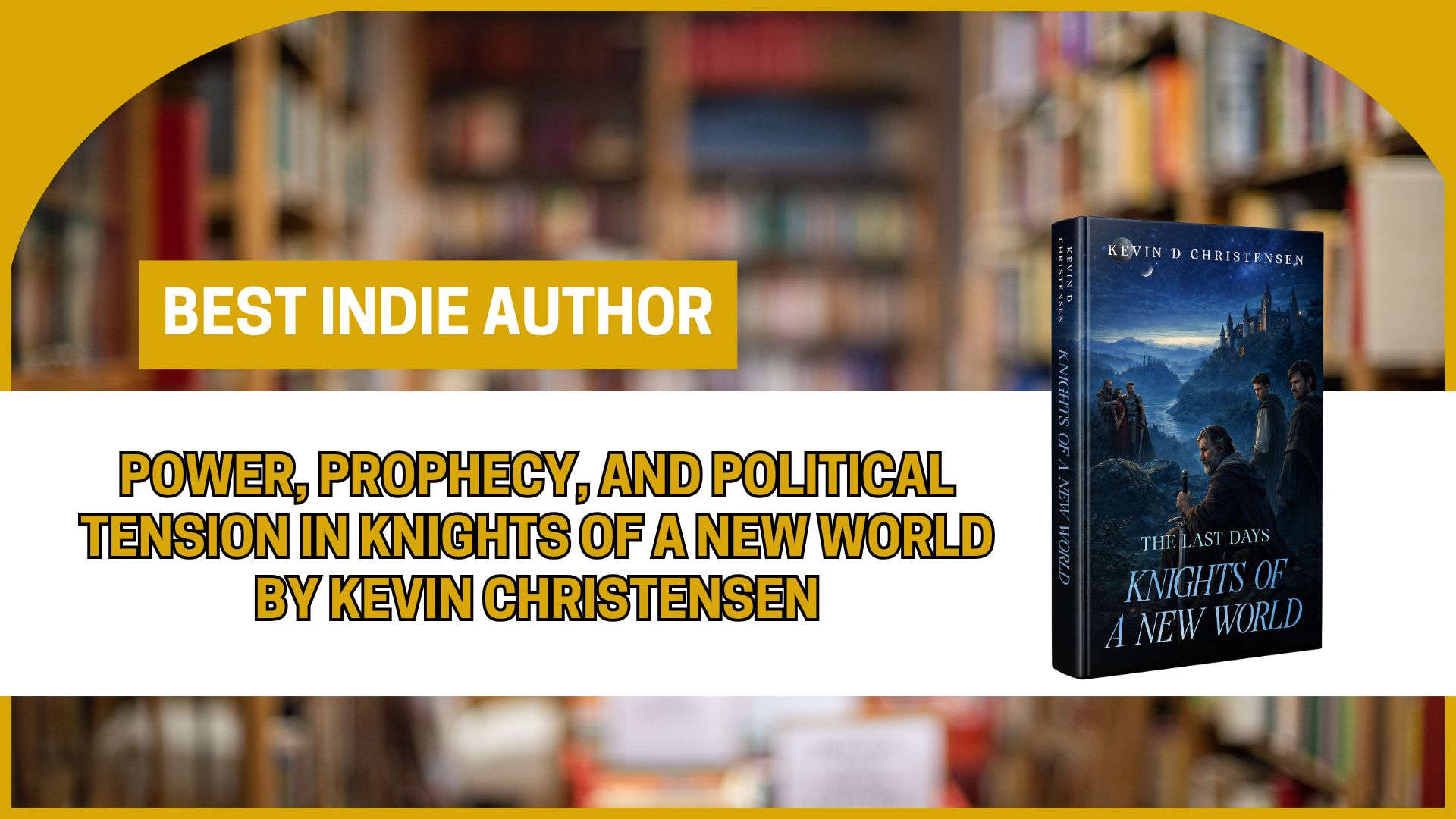
Kevin Christensen’s Knights of A New World brings readers into a charged alternate history where kingdoms, empires, and emerging political powers collide on the tense borderlands of Roman Britain. This is a novel shaped by ambition, fear, conviction, and the dangerous belief that the future can be controlled by those bold enough to seize it.
The story unfolds across a world where Rome still casts a long shadow, but its authority is no longer absolute. Tribal leaders, Roman officials, Atlantean powers, political reformers, soldiers, villagers, and religious voices all move through a landscape alive with unrest. The result is a gripping tale in which every alliance feels fragile and every decision carries consequences far beyond the moment.
At the centre of the novel is the struggle for power. Leaders argue over territory, taxation, education, slavery, native rights, and the shape of future government. Some want order. Some want profit. Some want reform. Others cling to control because fear has become their strongest weapon. Christensen uses this political tension to give the story weight, turning Roman Britain into a battleground not only of armies, but of ideas.
Prophecy adds another layer of urgency. Rumors of coming tribulation, warrior kings, divine warnings, and hidden signs move through the story like a gathering storm. For some characters, prophecy offers hope. For others, it becomes a threat, a mystery, or a tool that can be misunderstood by fearful men. This gives Knights of A New World a powerful sense of expectation, as readers are drawn into the question of whether the future is being revealed, resisted, or manipulated.
The novel’s strength lies in how these forces overlap. Political campaigns are not separate from spiritual questions. Military decisions are not separate from justice. Personal courage is not separate from public consequence. Characters such as Leia Sobek, James, Allen, Phillip, and General Maximus must navigate a world where truth is risky, loyalty is tested, and silence can be costly.
Leia’s presence brings fierce energy to the narrative. Her willingness to challenge authority gives the book one of its strongest moral currents. She speaks against ignorance, corruption, and oppression in a society that expects restraint from those without power. Through her, Christensen gives readers a heroine whose courage feels both personal and political.
For readers drawn to historical fantasy, alternate history, political drama, and stories of faith under pressure, Knights of A New World offers a vast and absorbing journey. Kevin Christensen builds a world where prophecy unsettles rulers, politics shapes destinies, and ordinary people are caught between fear and change. It is a story about what happens when power is questioned, when truth refuses to stay hidden, and when a new world begins to rise from the ruins of the old.