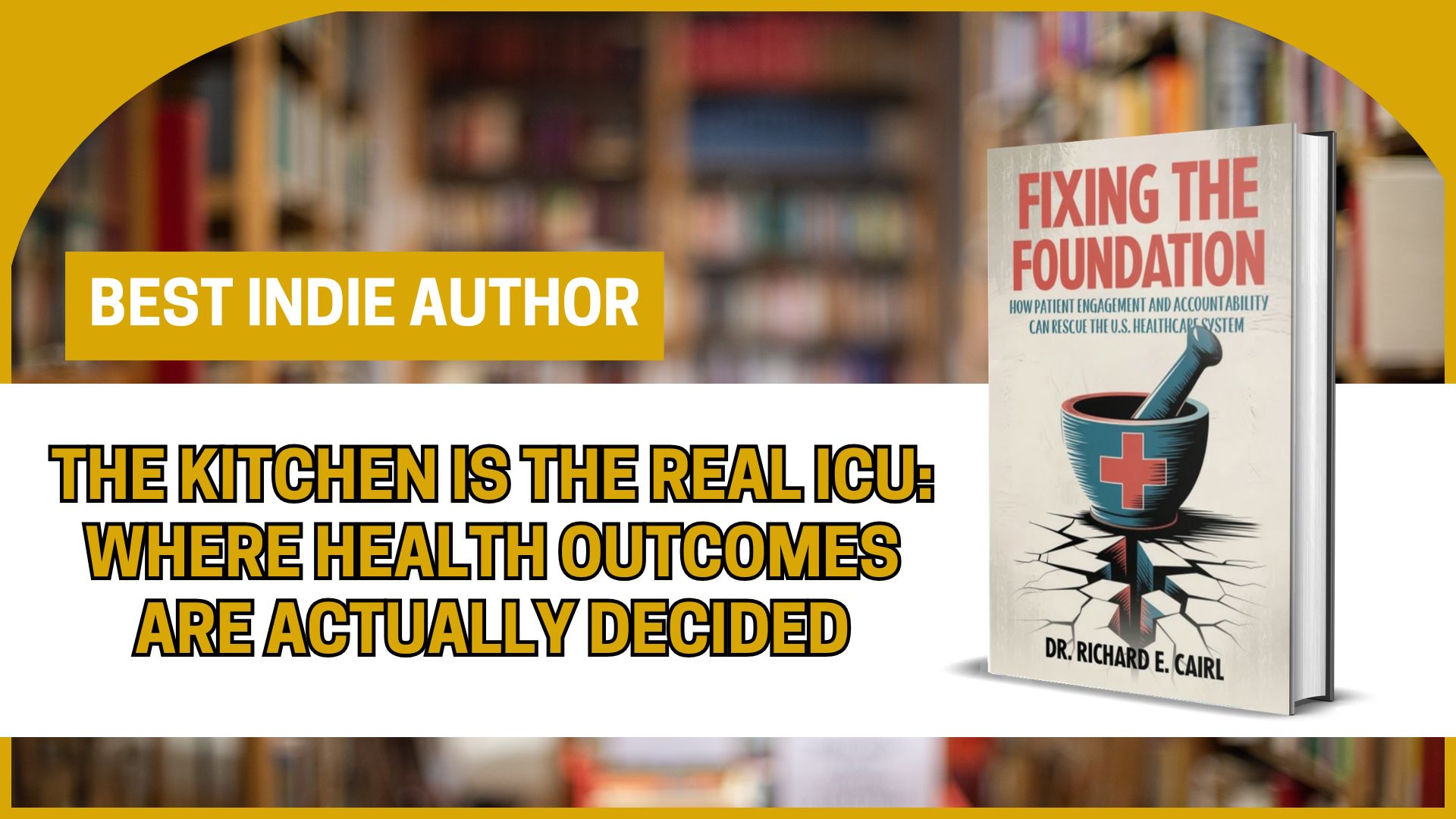
Modern healthcare is often imagined as a high-tech environment where life and death decisions are made in operating rooms, intensive care units and emergency departments. These settings are undoubtedly critical. But in Fixing the Foundation, Dr. Richard E. Cairl challenges a more uncomfortable truth: for most patients, the most important determinants of health are not decided in hospitals at all; they are decided in kitchens, living rooms, grocery stores and daily routines.
This shift in perspective reframes healthcare entirely. The ICU may stabilize a patient in crisis, but it is what happens after discharge that determines whether that patient returns to health or returns to the hospital. Blood pressure control, diabetes management, heart failure stability, obesity reduction and mental health recovery are all profoundly shaped by behavior between clinical encounters. In that sense, the kitchen, not the ICU, is where outcomes are truly won or lost.
Dr. Cairl argues that this reality exposes a foundational gap in the U.S. healthcare system. While the system excels at acute intervention, it underperforms in supporting the continuous, everyday decisions that actually determine long-term health. Patients are often discharged with instructions, prescriptions and advice but without sustained structures that help translate those recommendations into daily life.
This is where the gap between knowledge and action becomes clinically significant. A patient may understand dietary restrictions for hypertension, but still struggle to implement them consistently. A patient may receive a life-saving medication, but miss doses due to routine, cost or confusion. A patient may be warned about early symptoms of deterioration, but fail to recognize or act on them in time. These small, repeated breakdowns accumulate into avoidable hospitalizations, complications and rising healthcare costs.
In Fixing the Foundation, Dr. Cairl identifies this as a failure of system design, not simply individual behavior. Healthcare has historically treated clinical care as the center of gravity, while daily life has been treated as peripheral. Yet it is in daily life where chronic disease is either controlled or allowed to progress.
The book proposes a different model: healthcare as a continuous partnership, where patient engagement and accountability are not optional add-ons but core infrastructure. In this model, the kitchen becomes a clinical space of its own, not because it is medicalized, but because it is where health decisions are enacted.
This is where emerging tools such as artificial intelligence and digital health systems become relevant. AI-enabled support systems can help bridge the gap between clinic and home by providing reminders, feedback, monitoring and guidance in real time. A patient managing heart failure can be alerted to early weight changes. A patient with diabetes can receive daily reinforcement of dietary choices. A patient on complex medications can be supported with simplified routines and timely prompts.
However, Dr. Cairl emphasizes that technology alone is not enough. AI can assist, but it cannot replace human responsibility. The success of any system still depends on patient engagement, asking questions, understanding instructions, disclosing barriers, recognizing warning signs and following through on agreed-upon plans. Likewise, providers must communicate clearly and design care that is realistic, accessible and supportive of real-world constraints.
This reframing has profound implications for healthcare reform. It suggests that improving outcomes does not depend solely on more intensive care in hospitals, but on better-supported care in homes. It requires shifting attention from episodic treatment to continuous health management.
Fixing the Foundation ultimately argues that the future of healthcare depends on acknowledging where health actually happens. Not only in operating rooms or ICUs, but in kitchens, where daily choices quietly determine long-term outcomes.
If healthcare is to become truly effective, it must follow patients beyond the clinic and into the spaces where life is actually lived. That is where the real ICU is.